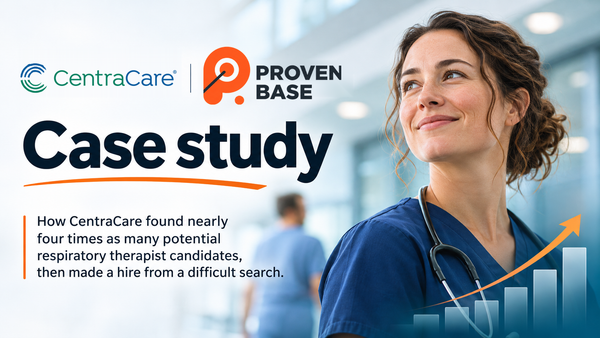
105 to 407: A Bigger Talent Market
How CentraCare discovered 407 potential respiratory therapist candidates in minutes, made its first hire within two weeks and continues to engage additional candidates identified by ProvenBase.


How CentraCare discovered 407 potential respiratory therapist candidates in minutes, made its first hire within two weeks and continues to engage additional candidates identified by ProvenBase.

When healthcare recruiting gets difficult, spending more money isn't always the answer. Sometimes, the problem is where you're looking.

New research suggests AI can remove workplace barriers, improve productivity, and expand access to employment. For employers struggling to find talent, that could change how they think about workforce availability.

A data-backed sourcing guide with resource links, employment statistics, and an actionable 30-day recruiting plan.

Employers are moving beyond basic AI skills, but many recruiting practices are still built around yesterday's requirements. That disconnect could be hiding the talent companies need most.

Hospitals are facing a difficult staffing problem. Physician positions remain open, patient appointments are delayed, and existing medical teams are stretched thin. Some hospitals are responding by hiring more nurse practitioners (NPs) and physician assistants (PAs). But depending on the state, these clinicians may face restrictions on the care they
ProvenBase just got smarter! Meet CodeLens, our new way to discover technical talent through real coding experience. Enjoy a simpler, more flexible search experience, and let Call Copilot assist with and transcribe your candidate interviews and team meetings. Three upgrades. Less busywork. Smarter recruiting. Codelens ProvenBase launched CodeLens: For healthcare

Healthcare added jobs in August. Just not at its recent pace. That distinction matters. A slower monthly hiring number can reflect budgets, delayed approvals, cautious employers, hard-to-fill openings or ordinary survey variation. It does not automatically mean workforce demand has weakened. It certainly does not prove that a hospital has

One of the biggest changes in healthcare recruiting isn't happening on a job board. It's happening inside employment contracts. For years, hospitals and healthcare organizations have relied on non-compete agreements to protect their investments in physicians and other medical professionals. I understand the reasoning. Recruiting a

The next breakthrough in recruiting may come from recognizing skills we've been overlooking. When a difficult position stays open for months, we question compensation, candidate availability, and recruiting strategies. But there is another possibility worth considering. What if qualified people already exist, but we're overlooking them

Candidate discovery is getting faster, but a profile match is not proof of identity, current capability or valid credentials. U.S. talent teams need a risk-based verification process that connects candidate claims to reliable evidence, separates sourcing checks from regulated background screening and preserves human judgment before employment decisions are

Recruiting teams receive more applications than ever, yet healthcare systems and manufacturers still cannot fill critical roles. The missing piece is visibility.

An AI sourcing agent can search, rank and engage candidates while recruiters focus elsewhere. But speed without visibility creates a new problem...

Manufacturing job openings rose while completed hires declined, signaling friction between workforce demand and hiring outcomes.

“Healthcare shortage” has become a catch-all diagnosis. When a role stays open, the default explanation is often that there are not enough qualified people. Sometimes that is true. But national supply is only one part of the hiring equation.
I have spent a lot of time lately talking with recruiting leaders about a labor market that looks healthier on paper than it often feels in practice. The conversation usually starts the same way. Layoffs are low. Companies are holding on to people. There is still hiring activity. From a

A requisition opens. Finance approves the salary range. Recruiting estimates the cost per hire. The search begins. That sequence makes hiring look cleaner than it is.
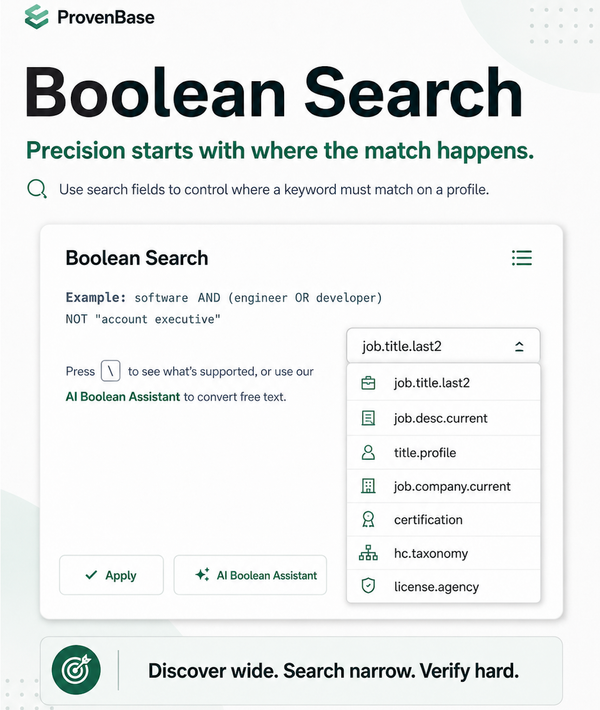
Before you begin a search, ask yourself this question: “ When a keyword matches a profile, where on that profile did it match? “ On most platforms you will never know. Does "Kubernetes" live in a job the candidate left in 2016? Or in a skills list they padded, or

The World Economic Forum says 39% of skills will be obsolete by 2030. The survivors? Empathy, creativity, judgment. The skills most training programs ignore.

Sixty-nine percent of job seekers would reject an offer from a company with a bad employer brand, even while unemployed. Your strongest recruiting tool is your humanity.
You already use ProvenBase to find talent. Now see three ways to make sourcing, outreach, and recruiting workflows even easier. [ Explore What’s New 👇 ] 01 | PROVENBASE COMMAND Ask. Act. Get recruiting work done. Imagine telling ProvenBase what you need instead of clicking through multiple steps. ProvenBase Command can source and

Your interview process works exactly as designed. That is the problem

The energy industry has a hiring problem that cannot be solved by hiring faster. Demand for skilled people is rising across utilities, renewables, oil and gas, grid infrastructure, and energy technology. But the supply of experienced technical talent is not keeping pace. The International Energy Agency’s World Energy Employment

Grid resilience has become one of the energy sector’s defining priorities. Utilities are hardening infrastructure against extreme events. Grid operators are integrating new technologies. Billions of dollars are flowing into transmission, storage, automation, cybersecurity, and modernization. But every one of those investments creates a second requirement: Someone has to
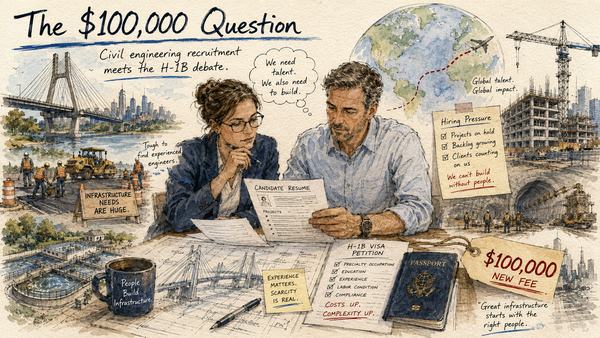
There is a difficult workforce conversation unfolding in civil engineering, at the intersection of infrastructure, immigration, and the practical realities of hiring. The catalyst is the new $100,000 fee for certain H-1B visa petitions. For an industry already struggling to find experienced engineers across transportation, water, infrastructure, and construction,

The Professional Engineer license exists for a serious reason. When civil engineers take responsibility for bridges, roads, water systems, drainage, buildings, dams, and other infrastructure, the public is trusting their judgment. Errors can cost millions of dollars, disrupt communities, and put lives at risk. Licensure is one of the profession’

There has always been a certain understanding on Wall Street. Young analysts join an investment bank, work hard for a few years, learn quickly, and many eventually move on. Private equity has become one of the most common destinations. What has changed is the timing. Private equity firms increasingly recruit

Public accounting has long sold itself as one of the best training grounds in finance. Young professionals enter the field, build technical discipline, earn credibility, work under pressure, and develop a foundation that can support an entire career. That part is true. The problem is what happens next. Public accounting

For a long time, manufacturing hiring followed a familiar pattern: a role opened, recruiting went to market, and the search began for someone who could step in and do the job. That model is becoming harder to sustain. Manufacturers are dealing with an aging workforce, persistent skills gaps, and factories

Manufacturing leaders keep talking about the skills gap. They are not wrong, but they are not telling the whole story. A 2024 Deloitte and Manufacturing Institute talent study projects that U.S. manufacturing could need as many as 3.8 million new employees between 2024 and 2033. If workforce challenges

Veterinary medicine has been talking about burnout for years. For much of that time, the responsibility seemed to fall on the individual. Clinicians were encouraged to become more resilient, manage stress better, and find healthier ways to cope. Those things matter. But they cannot fix an unhealthy system. Veterinarians and

Veterinary consolidation has become one of the industry’s favorite villains. For many clinicians, corporate ownership represents production pressure, centralized decisions, and less control over the clinical day. For operators, it can mean stronger benefits, modern systems, career pathways, professional management, and capital for growth. The Federal Trade Commission has

In July 2026, something that had long felt theoretical became real. Montefiore Medical Center laid off 12 utilization review nurses and announced that AI software from Datavant would take over their work. These nurses reviewed patient records, confirmed that treatment was medically necessary, and helped ensure that care would be

Hospitals talk about the nursing shortage as if it begins when a requisition opens. It does not.

The companies positioned to lead the next decade are hiring the best humans.

We are excited to welcome Danielle Moseley to ProvenBase as our Vice President, Revenue & Business Development. Danielle brings more than 20 years of experience serving the talent acquisition community and is widely recognized for building trusted relationships, developing strategic partnerships, and helping organizations grow. In her new role, she

Finding hidden talent is only half the job. The real challenge begins when every enrichment tool fails and you still need a reliable way to reach the right person.

Healthcare keeps selling calling. Workers keep calculating rent, debt, schedules, safety, and whether the job lets them have a life. The real talent war is not just hospital vs. hospital. It is healthcare vs. every other way to make a living.

Hospitals do not run on doctors and nurses alone. They run on the respiratory therapist, lab scientist, imaging tech, pharmacist, coder, and health information pro no one applauds until the system breaks. The invisible workforce was never invisible. It was load-bearing.

Healthcare leaders keep asking where the nurses went. Wrong question. Ask why so many nurses looked at the job they once loved and decided the bargain no longer made sense. You cannot recruit your way out of a job people are trying to survive.

America is aging into more medical need just as many physicians are aging out of the workforce. That is not a shortage. It is a collision. Healthcare recruiting cannot keep waiting for open reqs, job posts, and active applicants. The waiting room is filling faster than the pipeline.

AI talent poaching has become a corporate arms race. As bonuses soar and shortages deepen, leaders face a harder question: how do you compete for elite talent without crossing ethical lines or losing your best people?

Hiring now takes an average of 44 days, and the cost goes far beyond open roles. Bloated funnels, AI-generated applications, and slow decisions are turning recruiting delays into a growth problem.
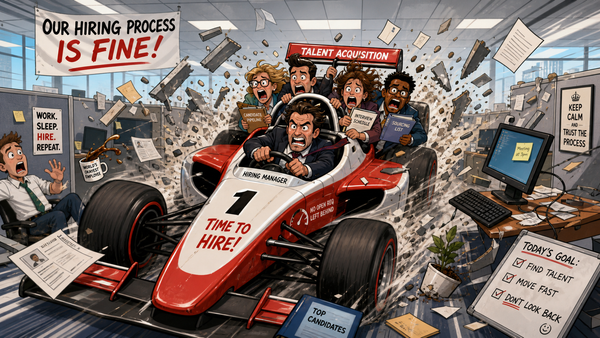
Hiring managers are taking on more recruiting responsibility as teams shrink and AI handles routine tasks. Done well, it can speed up hiring. Without structure, it can create bias, inconsistency, and costly mistakes.

What if pay had nothing to do with job titles? Skills-based compensation promises fairer rewards and mobility, but it also raises tough questions about bias, status, measurement, and what work is really worth.

The physician shortage is real. But it is often misunderstood. This is not just a supply problem. It is a geographic constraint problem. Physicians do not move the way other professionals do. They build careers within tightly defined regions shaped by training, licensing, family, and professional networks. The result is

Talent did not disappear from major markets. It moved. What was once concentrated in a handful of cities is now distributed across dozens of emerging locations. The shift is not temporary. It is structural, driven by remote work, cost pressure, and changing worker priorities. Most recruiting systems have not adjusted.

Time: Tue, Apr 21, 2026, 5 P.M - 7 P.M CST Location: Harvest Hall, 815 South Main St, Grapevine, TX Third Rail inside Harvest Hall Event link: https://www.linkedin.com/event/manage/7444601352804024320/

The workforce is not disappearing. It is disengaging from traditional hiring systems. A growing share of high-skill professionals are choosing independence over employment. They are working, earning, and building reputations outside the visibility of corporate recruiting infrastructure. This creates a structural blind spot. These individuals are not unemployed. They are

The talent pipeline is not shrinking. It is fracturing. For decades, employers relied on a stable system. Universities produced graduates. Degrees signaled capability. Recruiting systems were built to capture that flow. That system is breaking. Fewer students are entering traditional pipelines. More talent is emerging through alternative paths. And the

AI is compressing companies into solo startups. China is accelerating this shift while top talent goes independent and becomes harder to find, forcing hiring to rely on real world signals instead of resumes.

Executive Summary U.S. manufacturing is not facing a temporary hiring slowdown. It is confronting a structural workforce constraint that will shape industrial growth for the next decade. The data is consistent across studies. The available labor supply is aging. Replacement pipelines are insufficient. Skilled trades require multi-year development cycles.

Executive Summary Cybersecurity hiring is often framed as a headcount shortage. The data now suggests a more precise diagnosis. The constraint is not primarily the number of applicants. It is the alignment of highly specific, rapidly evolving skills with equally specific enterprise risk requirements. As artificial intelligence, cloud infrastructure, and

Why the February 2026 labor market shock is actually a signal and how smart HR leaders will respond. The February 2026 jobs report hit like a cold bucket of water. A net loss of 92,000 jobs against economist forecasts of a 60,000 gain was the first outright monthly

Executive Summary When a hospital system cannot fill a neurology role for five months, the default response is predictable. Post more jobs. Expand sourcing. Add a search firm. Those are rational responses to a volume problem. The data suggests healthcare is not facing a volume problem. It is facing a

Executive Summary Across industries, employers are facing a persistent contradiction: applicant volume is high, yet critical roles remain open for weeks or months. This is not simply a sourcing problem. It is a structural alignment issue inside the labor market. Recent analysis cited by the Society for Human Resource Management

Modern hiring rarely fails loudly. More often, it fails quietly. Roles remain open. Pipelines appear full. Systems report activity. Yet capable candidates never surface, and organizations struggle to explain why. The reason is not always visible bias or broken tooling. It is the accumulation of silent filters. These are the

Across executive teams, a quiet shift is underway. Hiring dashboards still report activity. Pipelines still look full. Recruiters still present confident updates. Yet many executives no longer trust what those outputs represent. This is not anecdotal. It shows up in turnover data, failed leadership hires, stalled initiatives, and repeated re-orgs.

For more than a decade, recruiting technology optimized for one outcome above all others: scale. More reach.More clicks.More applicants. What began as a proxy for market interest quietly became a core success metric. Applicant volume was easy to measure, easy to report, and easy to celebrate. A growing

The Hiring System Didn’t Break Overnight HR technology was built to solve a clear problem: scale. As hiring volumes increased, technology promised efficiency, fairness, and consistency. More data would mean better decisions. Automation would reduce bias. AI would help recruiters see further and move faster. That logic made sense
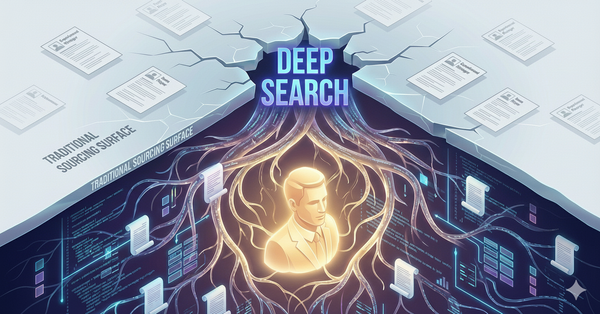
Modern recruiting teams face an unprecedented challenge: the talent they need is increasingly invisible to traditional tools. As industries accelerate—AI, cloud engineering, biotech, quantum computing—the experts driving innovation often do not appear on LinkedIn, job boards, or resume databases. The old sourcing methods simply cannot keep up. ProvenBase’

📅 February 2–4, 2026 @ San Diego ProvenBase will be exhibiting and showcasing at TA Week in San Diego from February 2–4, 2026. Let’s meet!

Startups are often at the forefront of breakthrough innovation, pushing the boundaries of what’s possible with emerging technology. That’s why we’re thrilled to share that ProvenBase has been recognized among leading startups shaping the future with Google Cloud. As part of SF Tech Week and the AI

ProvenBase will be attending DC Startup and Tech Week on October 22nd at International Square, Washington, DC. We’re excited to engage with innovators shaping the next wave of technology and AI-driven solutions.

📅 Oct 23rd at 11:30 EST @ Wildfire Restaurant. Location: 2001 International Dr, McLean, Virginia, US, 22102 Few more days! 🎉 ProvenBase is proud to be a sponsor of recruitDC, connecting and learning with the brightest minds in talent acquisition. We’re committed to helping recruiters uncover hard-to-find talent with the power

📅 Nov 4th - 5th, 2025, in San Diego, CA. We’re excited to share that ProvenBase will be attending the Recruiting Innovation Summit on November 4–5, 2025, in San Diego, CA. Our team will be hosting a booth where you can: * Experience live demonstrations of our Deep Search technology,

📅 October 15–16, 2025 📍 Booth #RF14 – Nashville Fairgrounds If you’ll be there, we’d love for you to stop by, meet our team, and see how ProvenBase is transforming Talent Acquisition. Looking forward to connecting with so many of you in person. 🎉

FAIRFAX, Va., June 23, 2025 /PRNewswire/ – ProvenBase, a leader in talent intelligence and recruitment technology, announces the release of Deep Search, an innovative sourcing feature designed to transform how companies discover top talent in an increasingly saturated digital hiring landscape. As recruiting teams face growing pressure to move faster and

A philosophical inquiry into the mass hypnosis of modern recruiting Let me ask you something that might make you uncomfortable: When did we decide that one platform, a single digital destination, should define the entire universe of available talent? I've been watching this industry for decades, and I&

Beyond the Obvious Continued pressure on Talent Acquisition to increase velocity in identifying skilled professionals while being provided with fewer resources has driven recruitment teams to adopt tools that provide “instant results” by searching large datasets of already indexed, categorized and aggregated profiles. However, there's a growing realization
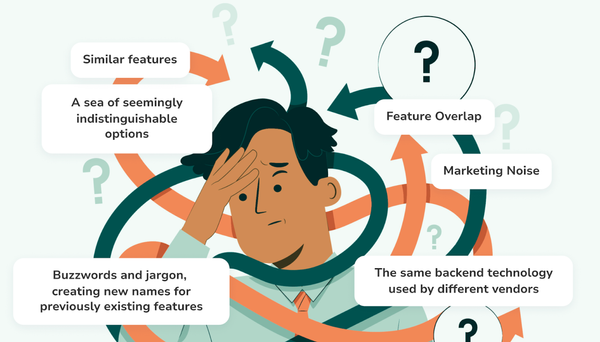
A shift has to happen from a catch-all approach of chasing every viable candidate to a strategic approach that focuses on targeted interactions with the best talent. Download our white paper to learn how to go from abundance to precision.
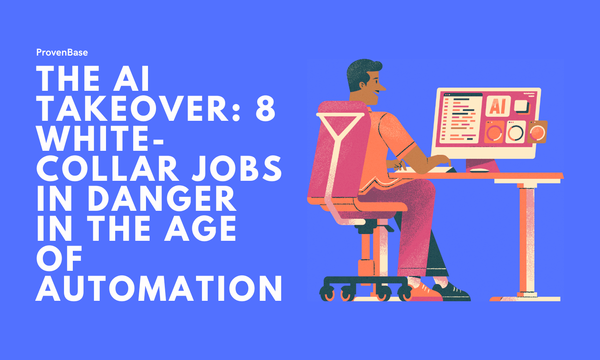
When AI came to the business world, we expected it to disrupt the blue-collar jobs the most. However, as we’ve seen through the last couple of years, it’s the white-collar jobs that are most shaken by this transformation. Around 19% of U.S. workers are facing job elimination

Candidate sourcing isn’t something that only companies with big budgets need. There are a couple of reasons why every company, no matter their size, complexity, or industry should use sourcing and in this article, we’ll elaborate on what those reasons are. But first, let’s define what sourcing
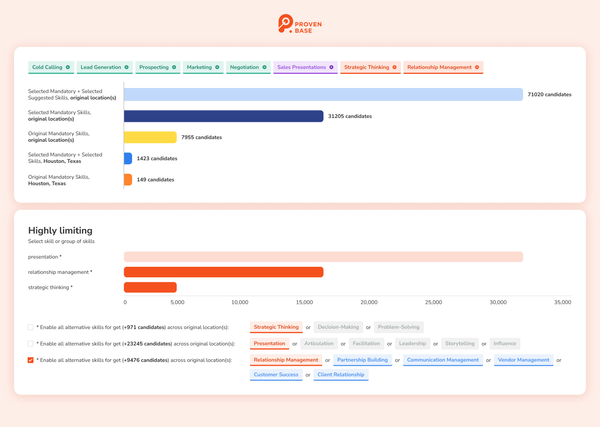
Learn how using talent intelligence in the workplace can be so impactful to your business.

The Why, How, And What Of A Quiet Talent Transition In The Age Of AI And Automation


Michael is also the former Director, Talent Acquisition and Diversity, Equity, & Inclusion at Xometry


Vaishali Shah, Vice President of Diversity & Inclusion at Randstad Enterprise Solutions


Director of Global Diversity, Inclusion, and Belonging at KnowBe4, Society for Diversity, and Chelly Consulting


Chief Diversity and Inclusion Officer and General Director of Talent Acquisition at BNSF Railway

Senior Vice President and Global Chief Diversity, Equity & Inclusion Officer at Factset


Diversity, Equity, & Inclusion Transformation Expert |Author | Speaker


Head of Corporate Talent Acquisition & Employer Branding at Total Wines & More


Senior Manager, Culture, Diversity, Equity & Inclusion, and Talent Management atTelesign


Chief Diversity, Equity & Inclusion Officer and Head of People Resources and Relations at Valley Bank


Global Head of Diversity, Equity and Inclusion at Blackhawk Network (BHN)


Executive Vice President & Chief Culture Officer at Atlanta Braves


News & Events
ProvenBase has partnered with Convo, a company offering ASL-interpretation services for workplace interactions like interviews and meetings.

Articles
Whether you’ve been recruiting for ages or you’re just starting to build out your pipelines, one thing is true: The perfect candidate is usually already employed. In fact, studies have shown that passive candidates are 120% more likely [https://www.glassdoor.com/employers/blog/5-tried-and-true-methods-for-sourcing-passive-candidates/] to have a