The Next Recruiting Battleground Is Candidate Verification

Candidate discovery is getting faster, but a profile match is not proof of identity, current capability or valid credentials. U.S. talent teams need a risk-based verification process that connects candidate claims to reliable evidence, separates sourcing checks from regulated background screening and preserves human judgment before employment decisions are made.
Recruiting technology can now find a candidate, assemble a profile and draft outreach in minutes. Generative AI can make an application look polished just as quickly.
The result is a strange new bottleneck. Talent teams can produce more possible matches, but they still need confidence that the person, experience and credentials behind each match are real and relevant.
This does not mean recruiters should treat every candidate as suspicious. It means discovery and verification have become separate disciplines. A larger pipeline is only useful when the team can identify which evidence deserves trust.
Why Is Candidate Verification Becoming a Recruiting Priority?
The most dramatic warning comes from remote technology hiring. In June 2025, the U.S. Department of Justice said North Korean IT workers used stolen and fake identities to obtain employment at more than 100 U.S. companies.
The scheme went far beyond résumé embellishment. Court documents described compromised identities, fraudulent websites, shell companies and U.S.-based “laptop farms” used to make overseas workers appear domestic. In April 2026, two U.S. facilitators were sentenced for their roles in a scheme that generated more than $5 million in illicit revenue.
These cases are extreme. They should not become an excuse for intrusive screening of every applicant. They do show what is possible when an employer accepts disconnected identity and career claims without a process for resolving inconsistencies.
For healthcare, manufacturing and other regulated industries, the stakes are different but equally practical. A recruiter may need to distinguish people with similar names, confirm the issuing authority behind a license or determine whether a required certification is current enough for the role.
What Does Candidate Verification Actually Mean?
Candidate verification is not one universal check. It has four distinct layers, each appropriate at a different point in the hiring process.
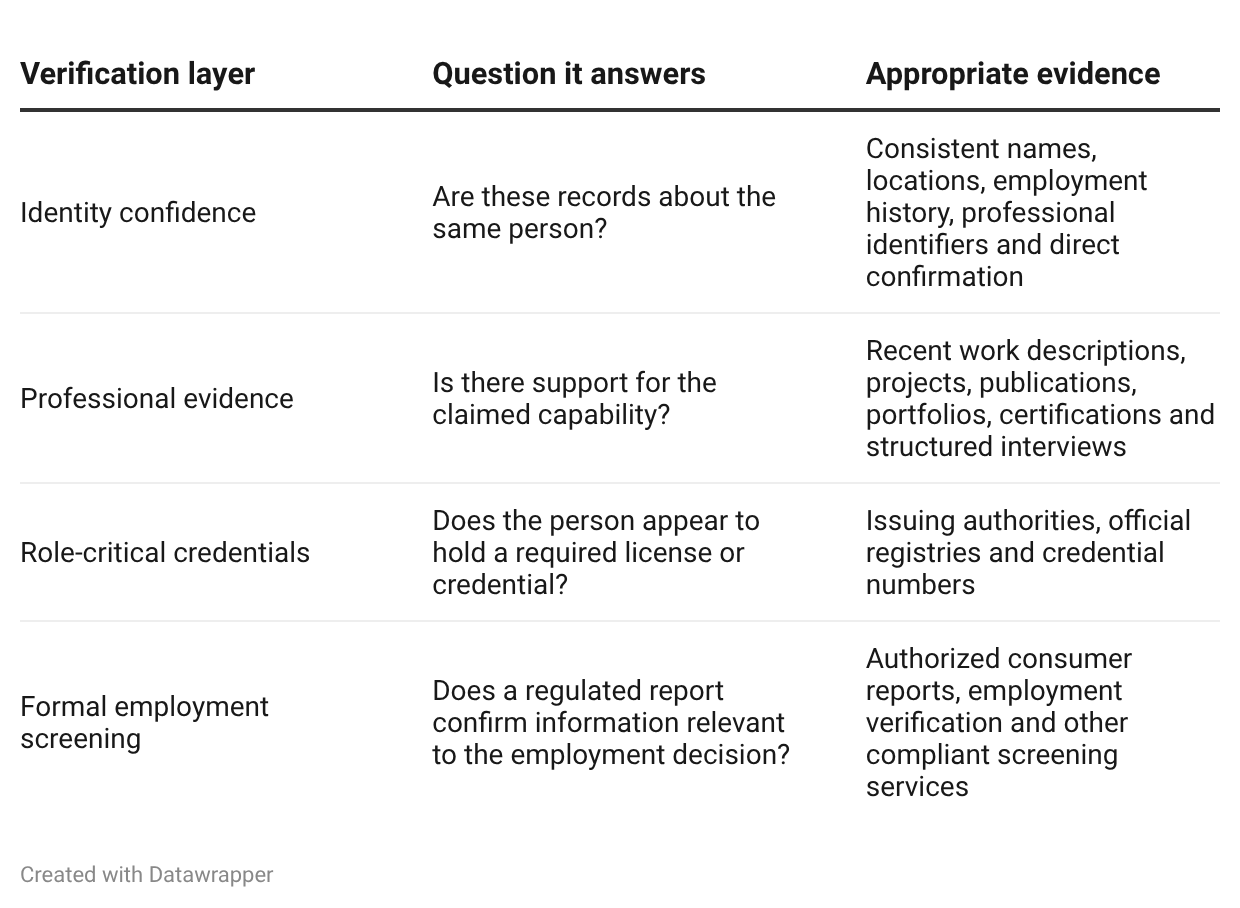
The layers should not be collapsed into a single “verified” label. Verified contact information, for example, can help a recruiter reach the right person. It does not prove that every professional claim associated with that contact is correct.
Why Is a Résumé or Profile Match Not Enough?
A conventional profile mixes several kinds of information: candidate-written summaries, employer-assigned titles, inferred skills, imported records and sometimes AI-generated language. Those elements do not carry equal weight.
Consider a maintenance engineer whose profile lists programmable logic controllers. The skill might appear in a general summary written years ago, a recent job description or a current certification. Each match is relevant, but each supports a different level of confidence.
Recruiters therefore need to ask two questions:
- Where did this information appear?
- How recent and authoritative is that source?
A match score without those answers can create false precision. The number looks definitive while the underlying evidence remains unclear.
How Can Recruiters Build a Risk-Based Verification Workflow?
The right level of verification depends on the role. A remote developer with access to source code presents different risks from an on-site sales associate. A clinician’s active license matters differently from a software certification.
Use a five-step workflow:
- Define the risk before searching. Identify the claims that would materially affect safety, legal eligibility, data access or job performance.
- Separate claims from evidence. Treat a self-reported skill as a lead, not final proof. Look for recent work, credentials or other job-related support.
- Resolve material inconsistencies. Similar names, conflicting dates and mismatched locations require human review, not automatic rejection.
- Verify critical credentials at the source. Use the relevant licensing board, registry or issuing authority when a credential is essential.
- Escalate formal screening correctly. When the process involves a consumer report, use an appropriate provider and follow applicable federal, state and local requirements.
The Federal Trade Commission explains that employers using consumer reports for hiring must comply with the Fair Credit Reporting Act. Requirements can include written disclosure, candidate authorization and specific procedures before and after an adverse action.
That regulated process should not be improvised inside a sourcing workflow.
How Can ProvenBase Support Evidence-Led Sourcing?
ProvenBase can help recruiters examine professional signals before outreach. Its search fields allow teams to distinguish a recent job description from a general skills claim, search certifications, filter by licensing agency and use healthcare identifiers such as NPI numbers.
Those distinctions matter. Three clinicians may share a name, but an NPI identifier can help a recruiter locate the relevant registry record. A certification field can identify a claim worth checking with the issuing organization. Recent-work filters can reduce the chance that an outdated skill is treated as current.
ProvenBase also provides verified contact information and direct source links. These features support candidate discovery and identity resolution, but they do not replace formal employment screening. ProvenBase’s terms state that the platform is not a consumer reporting agency and that customers remain responsible for evaluating information.
That boundary is useful. Sourcing technology should help recruiters find stronger evidence and ask better questions. Human reviewers and qualified screening providers should handle the decisions that require them.
What Should TA Leaders Do Next?
Audit one hard-to-fill role. List every candidate claim that affects the decision, identify the evidence currently used to support it and assign an owner for resolving discrepancies.
The next advantage in recruiting will not come from collecting the largest number of profiles. It will come from knowing which signals are current, which sources are authoritative and when a person must make the call.
About the Author
Jim Stroud is Head of Market Strategy & Industry Engagement at ProvenBase. A recognized thought leader with 20+ years in recruitment and HR tech, he has trained and worked with talent professionals at Google, Microsoft, Randstad and Siemens. An author, podcaster, and speaker, Jim shares insights on sourcing, labor markets, and the future of work.