Nurses Are Not Leaving Healthcare. Healthcare Is Pushing Them Out.
Healthcare leaders keep asking where the nurses went. Wrong question. Ask why so many nurses looked at the job they once loved and decided the bargain no longer made sense. You cannot recruit your way out of a job people are trying to survive.
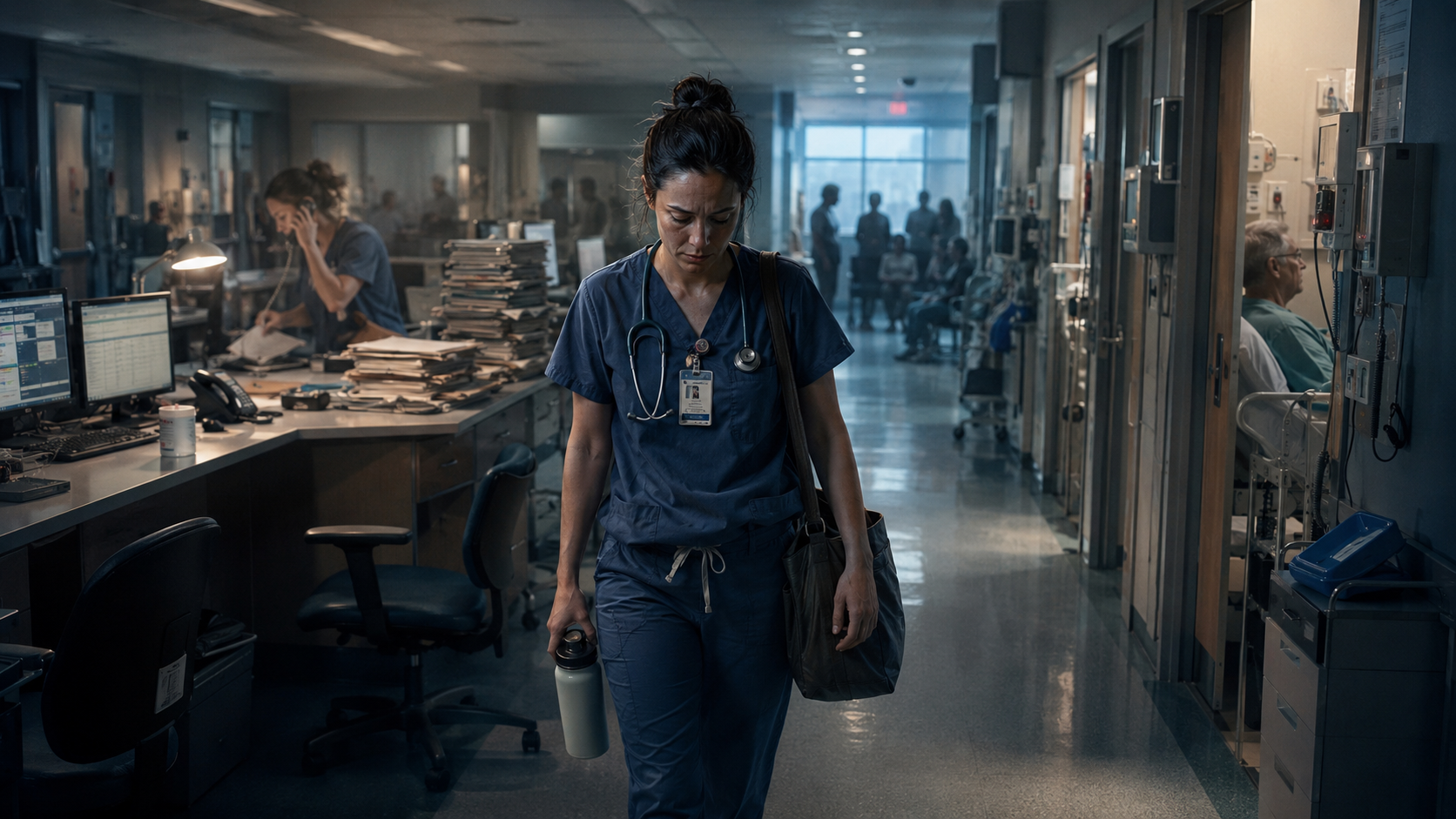
Healthcare leaders keep asking where the nurses went.
That may be the wrong question.
The better question is why so many nurses looked at the profession they trained for, sacrificed for and were once proud to join, then decided the bargain no longer made sense.
That is the uncomfortable part of the nursing shortage. It is not just a supply problem. It is not just a retirement problem. It is not just a nursing school capacity problem. Those things matter. But they do not explain the full wound.
The wound is deeper.
Nurses are not simply disappearing from healthcare. Many are being driven out by the work itself.
The National Council of State Boards of Nursing reported that about 100,000 registered nurses left the workforce during the COVID-19 pandemic because of stress, burnout and retirement. The same research found that another 610,388 registered nurses reported an intent to leave by 2027, and 188,962 nurses under age 40 reported similar intentions. That last number matters because it breaks the lazy explanation that this is only about older nurses retiring. Younger nurses are looking at the same system and wondering whether they want to spend their lives inside it.
That should scare every hospital executive, talent acquisition leader and recruiter in healthcare.
Because you cannot recruit your way out of a job people are trying to survive.
The shortage is not imaginary
There is a real math problem here.
The Health Resources and Services Administration projects nationwide shortages of 108,960 registered nurses and 245,950 licensed practical nurses by 2038. HRSA also projects larger RN shortages in nonmetropolitan areas, with an 11% shortage in nonmetropolitan areas compared with a 2% shortage in metropolitan areas by 2038.
The Bureau of Labor Statistics projects about 189,100 openings for registered nurses each year from 2024 to 2034. Many of those openings are expected to come from replacement needs, including workers who retire or leave the labor force.
That is the public version of the crisis. The spreadsheet version. The version that goes into planning documents and board presentations.
But the spreadsheet does not tell you what it feels like to work short-staffed. It does not capture the nurse who skips lunch again because there is no one to cover. It does not show the charge nurse doing triage, diplomacy, crisis management and emotional labor while everyone pretends this is normal. It does not show the young nurse driving home after a shift and wondering whether the degree was a mistake.
Healthcare loves to talk about resilience.
Too often, resilience is what leaders praise when they have run out of staffing ideas.
Compassion is not a staffing model
Nursing has always involved hard work. Nobody enters the field expecting comfort. But there is a difference between difficult work and unsustainable work.
The American Association of Colleges of Nursing reports that the median age of registered nurses is 50 and that about 40% of registered nurses say they plan to retire or leave nursing over the next five years.
That is not a small warning light on the dashboard. That is smoke coming from the engine.
Talent acquisition leaders should read those numbers differently than they did five years ago. This is not a call to hire more nurses in the abstract. It is a warning that retention and recruitment are now the same conversation.
Every nurse who leaves becomes a recruiting burden. Every understaffed unit becomes an employer brand problem. Every bad manager becomes a sourcing challenge. Every chaotic schedule becomes a competitor’s talking point. Every exit interview becomes market intelligence, whether anyone reads it or not.
Recruiters are often handed the hardest version of this problem. They are asked to sell the mission while candidates are asking about ratios, overtime, float expectations, violence prevention, onboarding, manager stability and whether the employer has burned out the last three people in the role.
That is not a recruiter problem.
That is an organizational truth problem.
The candidate has changed
The nursing candidate of today is not just asking, “What does this job pay?”
They are asking, “What will this job cost me?”
That cost may include mental strain, physical injury, missed family time, moral distress, administrative overload and the quiet fear of making a mistake in an unsafe environment. Better pay matters, but pay alone cannot erase a broken operating model.
This is where healthcare employers need to stop hiding behind generic messaging. “Join our mission” is not enough. Nurses already understand the mission. Many understand it better than the people writing the job ads.
What they need is proof.
Proof that staffing levels are taken seriously. Proof that leadership listens. Proof that onboarding is not sink or swim. Proof that career paths exist. Proof that a nurse can raise a concern without being labeled difficult. Proof that the employer has a retention strategy stronger than pizza, posters and appreciation week.
For recruiters, this changes the job. The best nursing recruiters are not just filling requisitions. They are reading the market. They know why nurses leave one facility for another. They know which managers have reputations. They know which shifts are poison. They know which competing employers are winning because they fixed a problem others only branded around.
In this market, recruiters need better intelligence, not just more job postings.
Better sourcing helps, but it cannot hide a bad job
This is where the conversation gets delicate.
Healthcare employers absolutely need stronger sourcing. The same obvious talent pools are being hit by everyone. The same nurses are being messaged by every hospital within driving distance. The same job boards are getting crowded with roles that all sound the same.
The advantage goes to teams that can find reachable talent before everyone else finds them, understand where the labor market is moving and build pipelines before desperation sets in.
That is where platforms like ProvenBase can fit into the strategy. Our platform helps recruiting and sourcing teams find healthcare talent from more than 10 million healthcare professionals, with tools designed to uncover hidden skills and candidates beyond traditional sources.
But here is the part that should cause concern.
Better sourcing can help you find nurses traditional systems miss. It cannot make a bad job feel like a good one.
That distinction matters because recruiters are not magicians. Technology can expand the map, sharpen targeting and improve outreach. It can help teams move faster and see talent they were missing. But if the job is unsafe, the schedule is punishing and the manager is a known problem, the market will find out.
Candidates talk.
Nurses talk faster.
The rural problem is worse
The nursing crisis is not evenly spread across the country. Some markets can hide the damage longer because they have more schools, more candidates, more competing employers and more mobility. Rural and nonmetropolitan areas have less room to absorb the shock.
HRSA projects a larger RN shortage in nonmetropolitan areas than in metropolitan areas by 2038. That means healthcare access could become more dependent on geography than most leaders are willing to admit.
For talent acquisition teams, rural recruiting cannot be treated as a less glamorous version of urban recruiting. It requires different messaging, different incentives, different community partnerships and a different understanding of why someone would move, stay or return.
A nurse with roots in a region may be more valuable than a nurse who simply matches a keyword search. A former local student, a military spouse, a nurse working in a neighboring state, a clinician with family ties nearby, or an LPN ready to advance may be part of the answer.
But you have to be able to find them.
That means healthcare recruiting has to become more precise, more personal and more intelligence-led.
The viral truth nobody wants on the brochure
The nursing shortage is what happens when compassion gets used as a staffing model.
For years, healthcare leaned on nurses to absorb the gap between patient need and operational reality. Nurses stayed late. Picked up extra shifts. Covered for vacancies. Trained new hires. Comforted families. Managed chaos. Smiled through it. Came back the next day.
Many still do.
But the old bargain is cracking.
Healthcare employers that understand this will stop treating nurse recruitment like a volume game. They will invest in retention, manager quality, workload design, internal mobility, smarter sourcing and honest messaging. They will use talent intelligence not to spam more candidates, but to understand the market before the market punishes them.
The ones that do not understand it will keep posting jobs, raising sign-on bonuses, blaming the pipeline and wondering why the floor still feels thin.
The nurses have been answering the question for years.
The system just has to decide whether it wants to listen.
Author
Jim Stroud is a labor market analyst and Head of Market Strategy and Industry Engagement at ProvenBase. His work focuses on structural hiring gaps, occupational mismatch, and visibility failures in modern talent acquisition systems.