Why Time-to-Hire Hit 44 Days in 2026
Hiring now takes an average of 44 days, and the cost goes far beyond open roles. Bloated funnels, AI-generated applications, and slow decisions are turning recruiting delays into a growth problem.
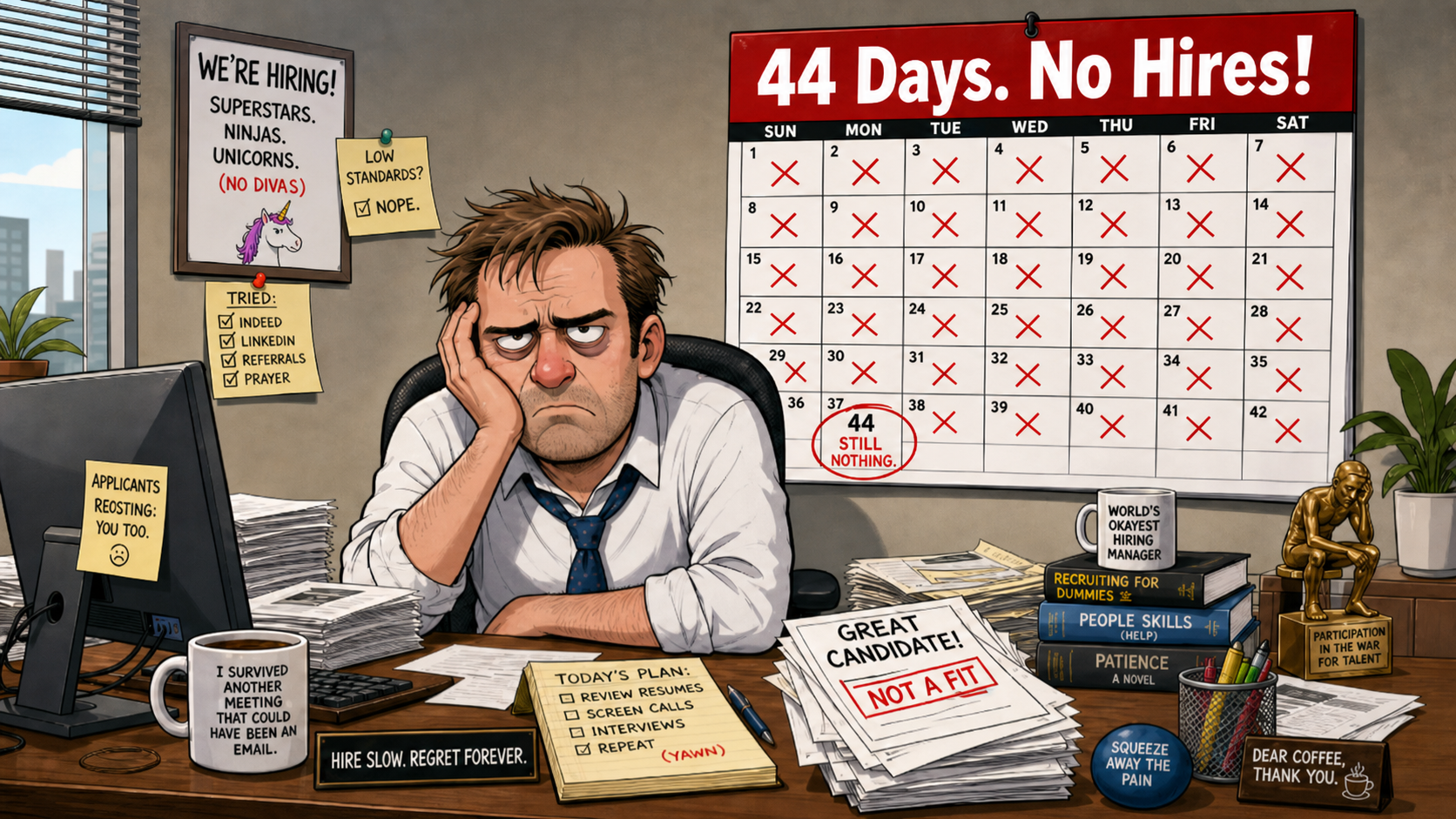
The hidden drag on business growth
Hiring is taking longer. Not a little longer. A lot longer.
The average time-to-hire in the United States has climbed to 44 days in 2026, up from 33 days in 2021. Some specialized pipelines now stretch to 60 or even 68 days. And while AI tools promised to make recruiting faster, they have, in many ways, made it slower. In 2026's high-volume, low-conversion environment, a sluggish hiring process is not just an inconvenience. It is a strategic liability.
The current state
The trend is clear across every benchmark. The average time-to-fill reached 42 days in 2025, a 24% increase since 2021. But that average masks wide variation by industry.
Technology roles average 25 to 35 days. Specialized positions like software engineering and data science often push to 35 to 45. Healthcare and life sciences face steeper timelines, with licensed clinical roles taking 45 to 60 days, and some exceeding 120 days because of credentialing and compliance requirements. Financial services roles run 35 to 50 days, stretching past 60 for anything requiring specific licenses or SEC clearances.
Four forces are driving these delays.
Bloated funnels. The number of applicants per job posting has nearly doubled, from 46 in 2021 to 95 in 2025. More volume does not mean more signal. It means more noise, and more time spent processing candidates who were never a fit.
Too many interview rounds. The average hire now involves 20 interviews, up 42% from 14 in 2021. Candidates want two rounds. Most employers require four or more. That gap is where top talent disappears.
AI-generated application overload. The same AI tools that candidates use to flood inboxes are overwhelming the teams supposed to screen them. A Robert Half survey found that 67% of U.S. HR leaders say reviewing AI-generated applications has slowed their hiring process, and 65% find it harder than ever to verify actual candidate skills.
Economic caution. When business conditions feel uncertain, companies chase the "perfect" hire. That search takes time no team can spare.
What delays actually cost
The direct costs are measurable. A vacant position costs between $4,129 and $5,733 per month, and that figure multiplies fast for senior or specialized roles.
The indirect costs are worse. When roles sit open, existing employees absorb the work. Those covering the gap are 68% more likely to burn out, and 2.6 times more likely to leave, which creates the next vacancy before the first one is filled.
Delay also drives away the candidates you most want. Between 50% and 60% of candidates abandon applications because the process moves too slowly. In a market where 90% of companies missed their hiring goals in 2025, speed is not a nice-to-have. It is a competitive edge.
Why processes stall
Most hiring delays are not caused by a shortage of talent. They are caused by structural problems that compound each other.
Sequential processes are the first culprit. When each hiring stage must be approved before the next begins, a single unavailable decision-maker can freeze everything. Parallel stages are faster, but most organizations have not made the switch.
Poor intake alignment is the second. When recruiters and hiring managers do not agree on what a role requires before the search begins, mismatched candidates flood the funnel. That alignment conversation, skipped to save time, costs weeks.
Manual screening is the third. With applicants per posting doubling, reviewing resumes by hand is no longer viable. Teams that have not automated initial screening are fighting a losing volume battle.
Decision paralysis is the fourth. The "perfect fit" obsession leads hiring managers to hold out for a candidate who rarely exists. That wait burns out recruiting teams and often ends with the same quality of hire they could have made weeks earlier.
What high-performing teams do differently
The organizations that hire fast do not cut corners. They cut waste.
Run parallel, not sequential. Conducting background checks and skills assessments alongside later-stage interviews, rather than after them, compresses timelines without sacrificing quality.
Screen for skills, not credentials. In 2024, 45% of organizations removed bachelor's degree requirements for some roles. Focusing on verified skills filters out the credential-inflated noise that floods every applicant pool.
Use AI where it actually helps. AI screening tools applied to initial evaluation can reduce time-to-hire from 44 days to as few as 11, a 75% reduction. The key is deploying AI at the top of the funnel, where human judgment matters least, not the bottom, where it matters most.
Set and enforce service level agreements (SLAs). SLA adherence can cut hiring time by up to 60%. Structured feedback deadlines between talent acquisition and hiring managers create the accountability that most processes lack.
Build pipelines before you need them. With 87% of companies facing skills shortages, waiting for a vacancy to begin sourcing is a losing strategy. Continuous sourcing keeps warm candidates ready before the role opens.
Track the right metrics. Time-to-fill is a lagging indicator. Stage-by-stage drop-off rates, time-per-stage to isolate specific bottlenecks, and candidate Net Promoter Score (NPS) are the numbers that drive real improvement.
The bottom line
Speed and quality in hiring are not in conflict. Organizations that run structured, parallel processes with skills-based screening and enforced feedback loops cut their time-to-hire by 30% to 50%, without trading off on candidate quality.
The 44-day average is not inevitable. It is a process problem. And process problems have solutions.
Author
Jim Stroud is a labor market analyst and Head of Market Strategy and Industry Engagement at ProvenBase. His work focuses on structural hiring gaps, occupational mismatch, and visibility failures in modern talent acquisition systems.