Your AI Sourcing Agent Needs an Evidence Trail
An AI sourcing agent can search, rank and engage candidates while recruiters focus elsewhere. But speed without visibility creates a new problem...

An AI sourcing agent can search, rank and engage candidates while recruiters focus elsewhere. But speed without visibility creates a new problem: teams cannot confidently review the agent’s work. A practical evidence trail should show the assignment, criteria, sources, reasoning, actions and human approvals behind every pipeline.
AI sourcing agents are moving recruiting from a series of manual searches to an always-on workflow. Give an agent an assignment and it can continue looking for prospects after the recruiter closes the laptop.
That productivity gain changes the management question.
The question is no longer only, “Did the agent find candidates?” It is also, “Can we understand how it found them, why it prioritized them and what it did next?”
For talent acquisition leaders, that record is the evidence trail. It helps recruiters evaluate quality, diagnose weak results and keep human judgment attached to consequential decisions.
What Is an Evidence Trail for an AI Sourcing Agent?
An evidence trail is a reviewable record of the inputs, decisions and actions that produced a candidate pipeline. It should allow a recruiter or TA leader to reconstruct the sourcing process without guessing how the system arrived at its output.
At minimum, it should answer seven questions:
- What assignment did the recruiter give the agent?
- Which requirements, preferences and exclusions shaped the search?
- What sources contributed to each candidate profile?
- What evidence connected a candidate to the role?
- Why did the agent rank one prospect above another?
- Which outreach or pipeline actions occurred automatically?
- Where did a person review, change or approve the work?
Each answer supports an operational decision. If the pipeline is too narrow, the team can inspect the criteria. If candidate quality is inconsistent, it can examine the supporting evidence.
Why Do U.S. Employers Need More Visibility Into Hiring AI?
There is no single federal law that creates one evidence-trail standard for every American sourcing tool. Existing anti-discrimination laws still apply, however, and state and local requirements are becoming more specific.
The U.S. Equal Employment Opportunity Commission has stated that employment technologies must comply with the federal civil-rights laws it enforces. The agency has also warned that AI tools can mask, perpetuate or introduce discriminatory barriers.
Several jurisdictions have added more explicit requirements:
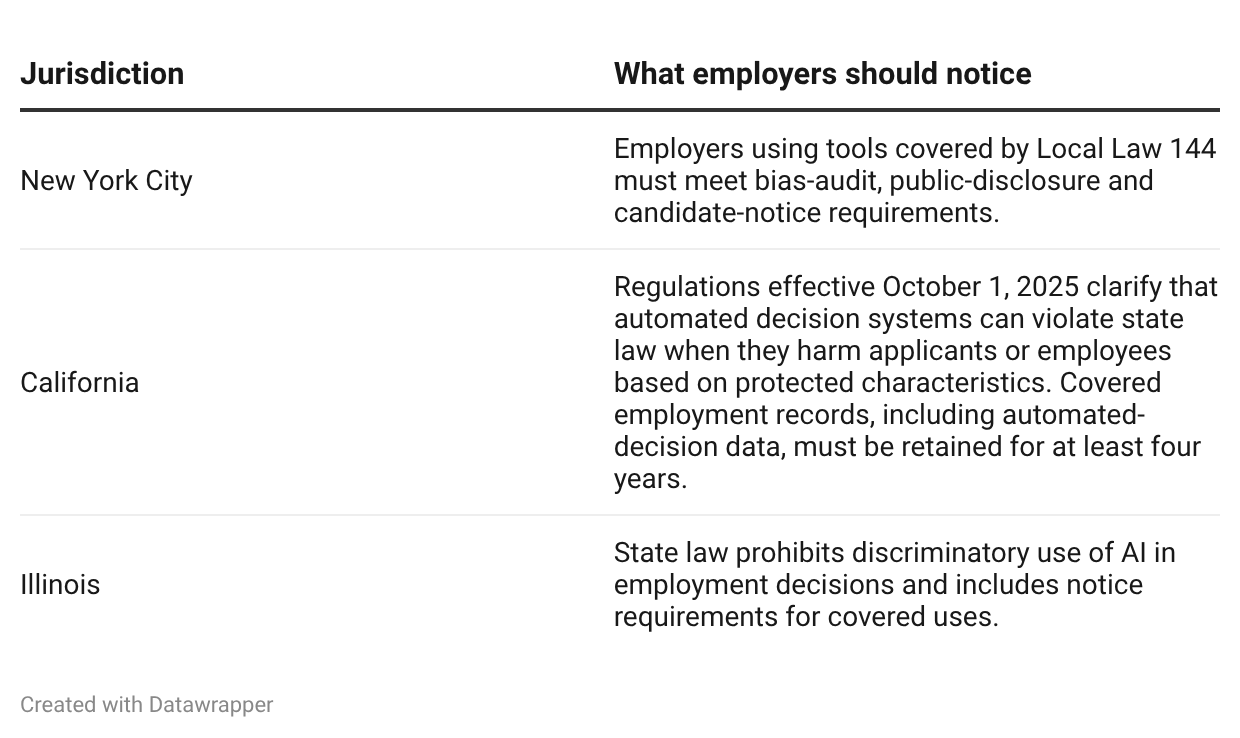
The details and definitions matter. A sourcing agent is not automatically an automated employment decision tool under every law, and a record does not by itself establish compliance. Employers should assess each use case with qualified counsel.
The larger direction is still clear: “The system produced this list” is becoming a weaker answer. Employers need enough visibility to examine how automation affected the recruiting process.
What Should Recruiters Be Able to Review?
1. The original assignment
Save the role, location, experience parameters, credentials and other instructions given to the agent. If the assignment changes, retain the change rather than silently replacing the original.
2. Search criteria and exclusions
Teams should be able to see which criteria acted as requirements, preferences or exclusions. This distinction matters. A preference treated as a hard filter can remove qualified people before a recruiter sees them.
3. Candidate-level evidence
A profile should show the information supporting the match, not merely a score. That might include recent skills, relevant industry experience, credentials or evidence found across multiple public sources.
4. Ranking rationale
Recruiters do not need every mathematical calculation. They do need an understandable explanation of the job-related evidence influencing the ranking.
5. Automated actions
If an agent unlocks contact information, drafts outreach, sends messages or manages follow-ups, those actions should be visible. Recruiters should know what happened, when it happened and under whose authorization.
6. Human intervention
Record when a recruiter reviewed a prospect, changed a criterion, overrode a recommendation or approved outreach. Human oversight is meaningful only when people can understand the output and act on it.
7. Outcome feedback
Connect sourcing activity with recruiter review, candidate response and pipeline progress. This helps teams improve assignments while watching for patterns that deserve investigation.
How Does an Evidence Trail Improve Sourcing Performance?
The same visibility that supports oversight helps teams improve results.
Suppose an agent returns very few maintenance technicians. Without an evidence trail, the recruiter may conclude that the market lacks qualified talent. With one, the team might discover that the search required an exact title, a narrow industry and several credentials simultaneously.
Now the recruiter can exercise judgment. Which requirement is truly essential? Which skill can transfer from an adjacent industry? Which credential can be earned after hire?
The agent accelerates the work. The evidence trail helps the human improve it.
How Should TA Leaders Evaluate an AI Sourcing Agent?
Before expanding an agent across more roles, run a structured review:
- Can recruiters see the assignment and every material change?
- Can they distinguish requirements from preferences?
- Can they inspect the evidence behind a candidate match?
- Can they understand why candidates were prioritized?
- Can they review every automated outreach action?
- Can authorized users pause, correct or override the workflow?
- Can the organization retain the records its policies and applicable laws require?
A polished candidate list is not enough. The system should make its work reviewable by the people accountable for hiring outcomes.
Where Does ProvenBase Fit?
ProvenBase AI Sourcing Agents continuously search for candidates, then rank, analyze and organize strong prospects for recruiter review. They can also support contact discovery, personalized outreach and follow-up workflows.
That human review point matters. The goal is not to remove recruiters from sourcing decisions. It is to give them more reach while preserving the context needed to evaluate the results.
As TA teams adopt agent-driven workflows, the strongest systems will not simply do more work. They will help people see, question and improve that work.
About the Author
Jim Stroud is Head of Market Strategy & Industry Engagement at ProvenBase. A recognized thought leader with 20+ years in recruitment and HR tech, he has trained and worked with talent professionals at Google, Microsoft, Randstad and Siemens. An author, podcaster, and speaker, Jim shares insights on sourcing, labor markets, and the future of work.