Healthcare Hiring Slowed. The Visibility Problem Did Not.

Healthcare added jobs in August. Just not at its recent pace.
That distinction matters. A slower monthly hiring number can reflect budgets, delayed approvals, cautious employers, hard-to-fill openings or ordinary survey variation. It does not automatically mean workforce demand has weakened. It certainly does not prove that a hospital has exhausted the available talent market.
For talent acquisition leaders, the more useful question is not, “Is there a healthcare shortage?”
It is, “Which shortage are we dealing with?”
How Much Did Healthcare Hiring Slow in August 2026?
According to the U.S. Bureau of Labor Statistics, healthcare employment increased by 13,000 in August 2026. That was below the sector’s average monthly gain of 32,000 over the previous 12 months.
Home healthcare services added 11,000 jobs and hospitals added 8,000. Other healthcare subsectors offset part of those gains. The August figures are preliminary and may be revised.
The hiring picture looks constrained when viewed beside the latest Job Openings and Labor Turnover Survey. In July, the combined healthcare and social assistance sector reported:
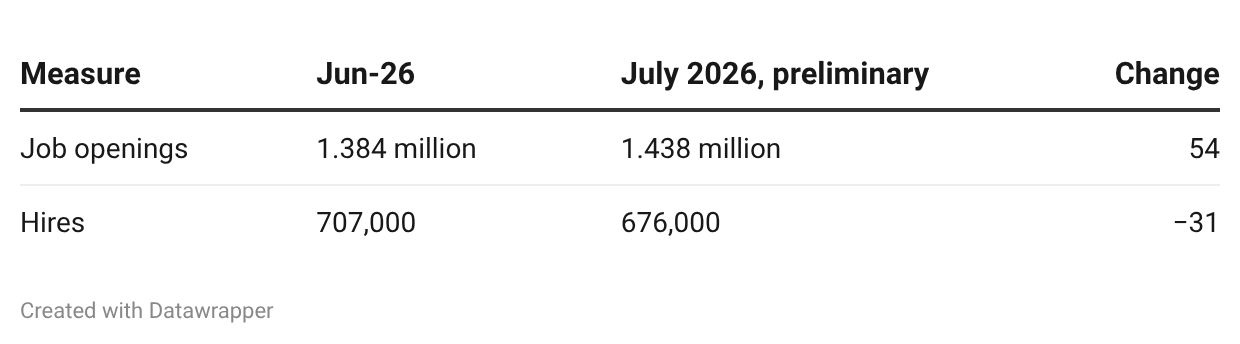
These figures do not isolate healthcare from social assistance, and one month cannot explain why openings rose while hires declined. They do show that slower hiring occurred alongside substantial unresolved demand.
Does Slower Hiring Mean Healthcare Needs Fewer Workers?
No. Monthly employment growth and long-term workforce demand measure different things.
BLS projects roughly 1.9 million openings per year across healthcare occupations from 2025 through 2035. That estimate includes new jobs and replacement needs when people permanently leave an occupation. It is a projection, not a count of current vacancies, but it shows why one slower month should not be mistaken for a lasting reversal.
Federal workforce projections also show genuine supply constraints. The Health Resources and Services Administration projects a national shortage of 141,160 physician full-time equivalents in 2038. It projects shortages in 30 of the 35 physician specialties modeled.
The pressure is not evenly distributed. HRSA projects physician supply adequacy of 42% in nonmetropolitan areas in 2038, compared with 95% in metropolitan areas. Geography changes the problem.
The same nuance appears in nursing. HRSA projects a national shortage of 108,960 registered-nurse FTEs in 2038, with a larger percentage shortage outside metropolitan areas. At the same time, it projects national nurse-practitioner supply above demand and identifies distribution as the central issue.
There is no single healthcare labor market. Specialty, location, license, setting and schedule all matter.
What Is a Healthcare Talent-Visibility Problem?
A supply shortage means the qualified workforce is insufficient for demand under the assumptions being measured. A visibility problem means qualified people may exist, but the employer’s recruiting process cannot reliably find or recognize them.
Visibility breaks down when:
- Recruiters search the same limited databases as every competitor.
- Inconsistent job titles hide the provider type or specialty.
- Relevant experience appears in work descriptions rather than headlines.
- Licensing information is fragmented across jurisdictions.
- Passive professionals maintain incomplete public profiles.
- Search criteria require an exact title when skills could transfer.
Visibility is not the only source of recruiting friction. A health system may identify qualified people but lack accurate contact information. It may reach them but lose them to compensation, scheduling, location, credentialing delays or a slow interview process.
Calling every one of these failures a “shortage” prevents the team from choosing the right intervention.
How Can Health Systems Diagnose an Unfilled Role?
Use a five-part diagnostic before increasing agency spend or concluding that the market is empty.
1. Supply
Does enough qualified talent exist in the relevant specialty and geography? Use labor-market data and credentialed-provider counts, not a national headline alone.
2. Visibility
What percentage of that market appears in the organization’s current sourcing channels? Test additional sources and search candidates by provider type, specialty and recent work rather than title alone.
3. Reachability
Can recruiters contact the people they find? Measure valid contact coverage, response rates and channel performance separately from search volume.
4. Requirements
Which criteria are legally or clinically essential, and which reflect preference? An unnecessary experience threshold, exact-title requirement or narrow radius can remove otherwise viable candidates.
5. Conversion
Where do qualified candidates leave the process? Examine outreach response, screening, interview scheduling, offer acceptance and credentialing. More sourcing will not repair a conversion failure.
How Can ProvenBase Improve Healthcare Talent Visibility?
ProvenBase provides specialized search across more than 10 million healthcare professionals. Its healthcare fields allow recruiters to search by NPI taxonomy, credentials and licensing agency rather than relying only on inconsistent job titles.
That can make the market easier to diagnose. Taxonomy can distinguish family medicine from a broad “physician” title. An NPI identifier can help resolve professionals with similar names. Licensing-agency filters can help recruiters focus on clinicians associated with a relevant jurisdiction.
ProvenBase also provides verified contact information and direct source links, helping teams move from discovery to outreach. These capabilities expand visibility and reachability. They do not create clinicians who are absent from the market, fix an unattractive role or replace formal credential verification.
That is precisely why diagnosis matters.
What Should Healthcare TA Leaders Do Next?
Choose one role that has remained open longer than expected. Estimate the qualified market, examine how much of it your team can see, audit unnecessary filters and identify where candidates leave the process.
Some searches will confirm a genuine supply constraint. Others will reveal overlooked providers, inaccessible contact data or an internal hiring bottleneck. Either result is more useful than applying the same “talent shortage” label to every vacancy.
About the Author
Jim Stroud is Head of Market Strategy & Industry Engagement at ProvenBase. A recognized thought leader with 20+ years in recruitment and HR tech, he has trained and worked with talent professionals at Google, Microsoft, Randstad and Siemens. An author, podcaster, and speaker, Jim shares insights on sourcing, labor markets, and the future of work.