Manufacturing Openings Rose. Hiring Fell. What Happened?
Manufacturing job openings rose while completed hires declined, signaling friction between workforce demand and hiring outcomes.

Manufacturing job openings rose while completed hires declined, signaling friction between workforce demand and hiring outcomes. The cause is not automatically a labor shortage. Employers must distinguish among limited supply, poor talent visibility, restrictive requirements, weak attraction and slow hiring processes before choosing a solution.
The easy explanation is that manufacturing has a talent shortage.
The more useful answer is that manufacturers may be dealing with several different problems at once. Until employers identify the actual source of the friction, they risk applying the wrong solution.
How Much Did Manufacturing Job Openings Increase in July 2026?
The latest Job Openings and Labor Turnover Survey from the U.S. Bureau of Labor Statistics illustrates the challenge.
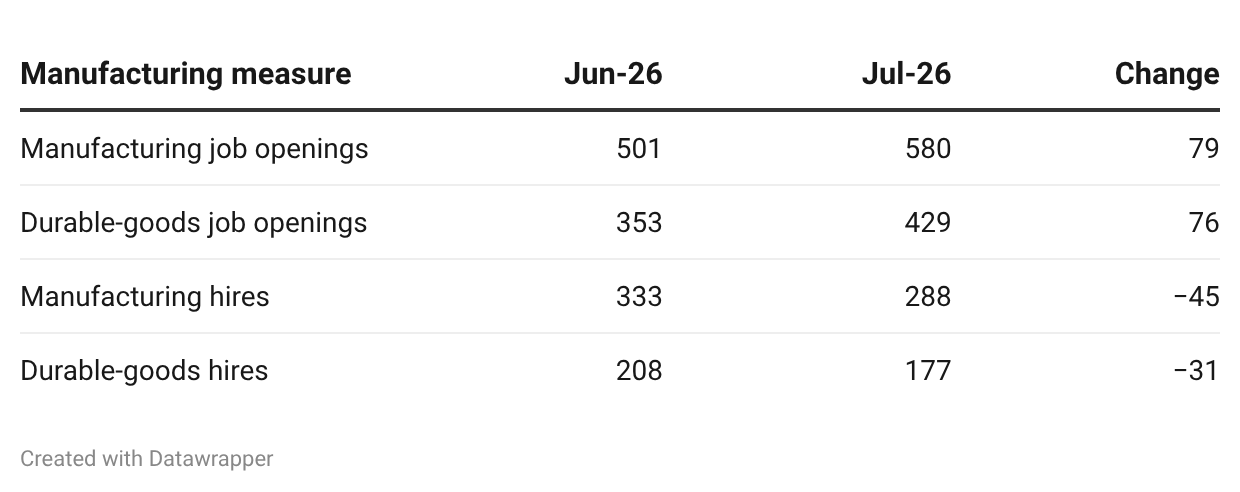
The July estimates are preliminary and may be revised.
Job openings are measured on the final business day of the month, while hires represent activity throughout the month. The numbers should not be treated as a direct conversion rate.
They still reveal an important pattern: reported demand increased while completed hiring declined.
Is Manufacturing Employment Still Growing?
Yes. The August employment report adds another layer to the story.
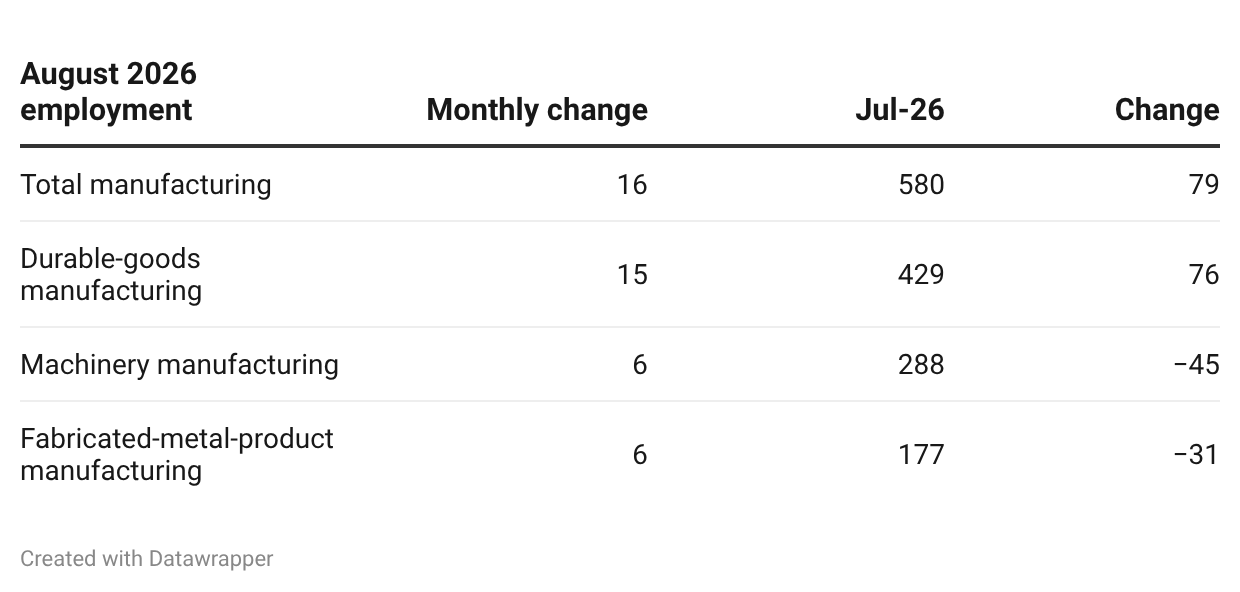
Manufacturing employment has risen by 58,000 since its recent low in December 2025. These figures are also preliminary, but they show that the sector continues to add workers even as employers report difficulty converting openings into hires.
This is not a story about manufacturing hiring disappearing.
It is a story about demand, supply and hiring activity moving at different speeds.
Why Do Manufacturing Positions Remain Open?
When a manufacturing job remains open, the vacancy is often labeled a skills-shortage problem. Sometimes that diagnosis is correct.
Sometimes it hides the real issue.
A persistent opening may reflect one or more of five forms of hiring friction:
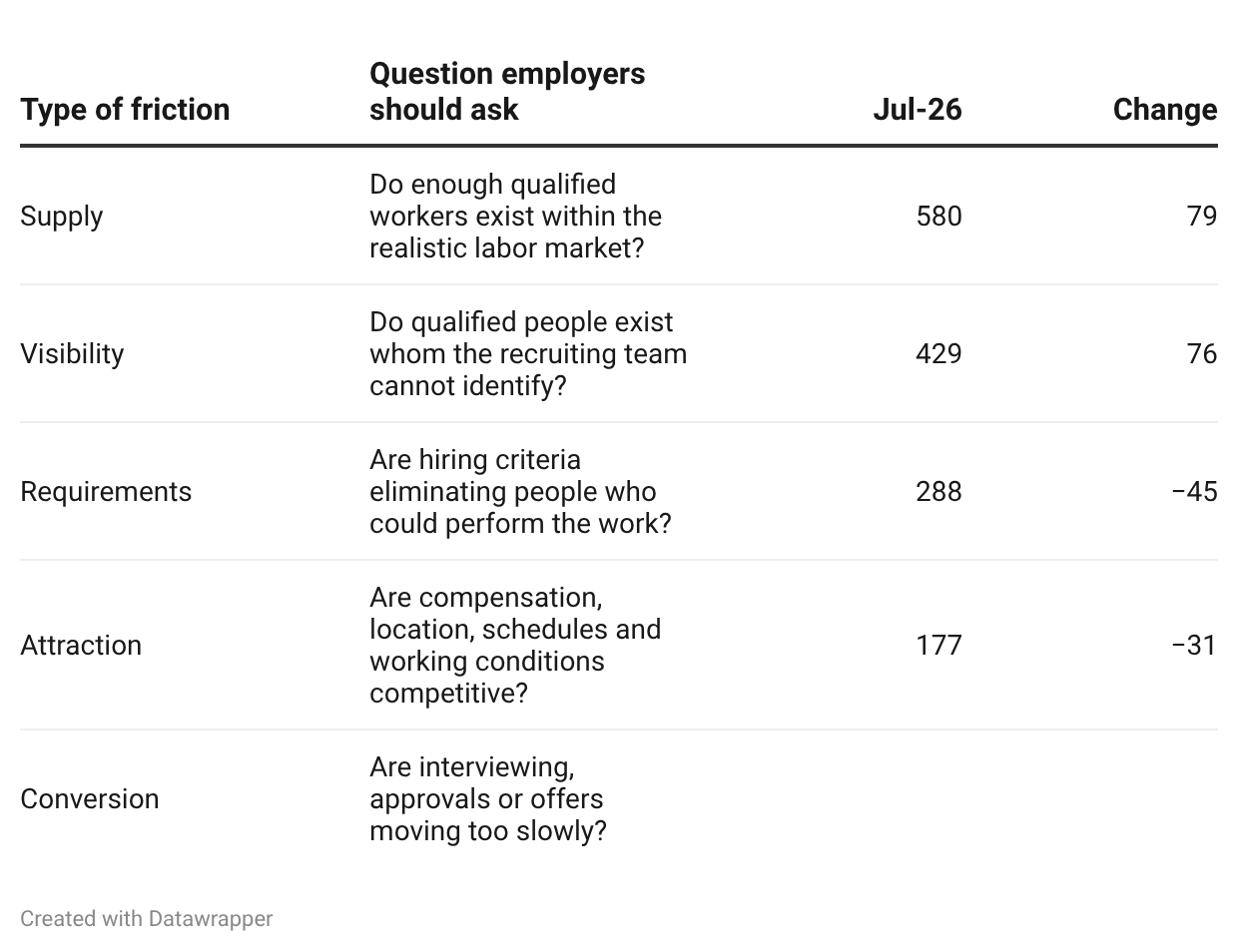
These problems require different responses.
A compensation problem cannot be solved by adding another sourcing platform. A slow interview process cannot be fixed by generating more applicants. A genuine regional shortage may require relocation support, training or a different workforce model.
But a visibility problem will not be solved by repeatedly searching the same database with the same job title.
Could Qualified Manufacturing Talent Be Hiding in Other Industries?
A September 2026 study from Deloitte and the Manufacturing Institute gives manufacturers a reason to reconsider where qualified talent might be found.
The researchers used data from the Department of Labor's O*NET system to analyze:
- Work activities
- Occupational knowledge
- Preparation pathways
- Transferable skills
- Employment projections
- Industry concentration
They organized manufacturing technicians into three groups:
- Advanced manufacturing technicians
- Maintenance and repair technicians
- Quality and laboratory technicians
The researchers then examined occupations outside manufacturing that shared similar capabilities.
Their analysis identified nearly 2 million technicians in adjacent industries whose broad capabilities may be transferable to manufacturing. These workers can be found in construction, retail trade, wholesale trade, government and other services.
That does not mean two million people are immediately qualified, available or interested in manufacturing work. Some would need training or additional technical knowledge. Regional conditions would also determine whether a transition is practical.
The finding still matters. It suggests that the potential talent market may be larger than a search limited to current manufacturing workers and familiar manufacturing titles.
How Is Manufacturing Technician Demand Changing?
Modern manufacturing increasingly depends on workers who operate across technical disciplines.
- Advanced manufacturing technicians support equipment design, testing, calibration and process improvement.
- Maintenance and repair technicians diagnose and repair mechanical and electrical systems.
- Quality and laboratory technicians test materials, interpret results and maintain data accuracy.
The Deloitte and Manufacturing Institute analysis estimates that manufacturing-technician employment could grow six times faster than production-occupation employment between 2025 and 2030.
It also estimates that employers may need to fill 2.3 million openings across manufacturing-technician and adjacent-industry-technician occupations during that period. Those openings include new positions and replacements created by retirements, workforce exits and occupational movement.
This will make title-based recruiting increasingly difficult.
A candidate's current title may not reveal experience with troubleshooting, preventive maintenance, quality control, industrial electricity, programmable logic controllers or related systems. Their most relevant capabilities may have been developed in another industry.
How Can Manufacturers Find Transferable Talent?
Manufacturers should not lower standards for safety-critical or technically demanding positions. They should examine whether those standards are being expressed in a way that helps recruiters find qualified people.
Recruiters and hiring managers should ask:
- Which capabilities are essential on the first day?
- Which skills can be taught after hiring?
- Which certifications are legally or operationally required?
- Which industries use similar equipment and processes?
- Which job titles may describe comparable work?
- Which geographic restrictions are necessary?
- Which requirements are preferences rather than necessities?
This conversation turns sourcing into workforce intelligence.
Instead of accepting every requirement as fixed, recruiters can show hiring managers how each condition changes the available talent pool.
How Can ProvenBase Help Diagnose a Talent Visibility Problem?
ProvenBase helps recruiting and sourcing teams investigate the visibility and requirements portions of the problem.
The platform searches talent across thousands of internet sources and allows recruiters to look for skills, experience, certifications and other relevant evidence. Certification searches can support manufacturing use cases involving credentials such as OSHA, NCCER and AWS welding certifications.
ProvenBase's Talent 360 feature also helps users see which criteria may be limiting a search and suggests different criteria that could expand the potential candidate pool.
That does not solve every manufacturing workforce challenge. ProvenBase cannot make an uncompetitive schedule attractive or accelerate an employer's interview process on its own.
It can help a recruiting team determine whether qualified people are being overlooked because the search is focused on familiar titles, industries or sources.
What Should Manufacturers Do Before Attracting More Applicants?
When openings rise and hires fall, the first response should not automatically be another job-board campaign.
Start by asking:
- Is the talent genuinely unavailable?
- Are qualified workers hidden in adjacent industries?
- Are requirements narrower than the work demands?
- Is the employment proposition competitive?
- Are qualified candidates being lost during the hiring process?
Manufacturing may have a workforce shortage, but that phrase is not a complete diagnosis.
The companies that fill critical roles will be the ones that understand the difference between a shortage of people and a shortage of visibility.
About the Author
Jim Stroud is Head of Market Strategy & Industry Engagement at ProvenBase. A recognized thought leader with 20+ years in recruitment and HR tech, he has trained and worked with talent professionals at Google, Microsoft, Randstad and Siemens. An author, podcaster, and speaker, Jim shares insights on sourcing, labor markets, and the future of work.