
The Jobs Report Nobody Is Reading Correctly
Why the February 2026 labor market shock is actually a signal and how smart HR leaders will respond.
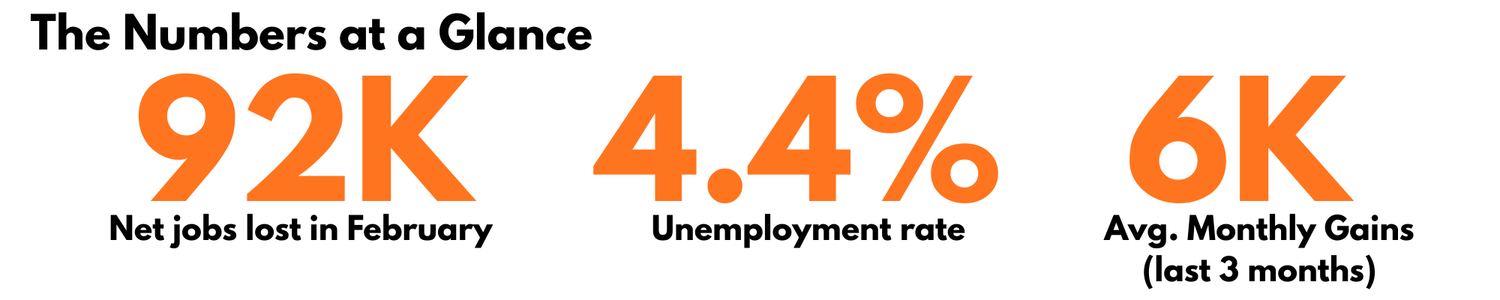
The February 2026 jobs report hit like a cold bucket of water. A net loss of 92,000 jobs against economist forecasts of a 60,000 gain was the first outright monthly decline since the pandemic recovery. Unemployment ticked up to 4.4%. Average monthly job creation over the past three months dropped to just 6,000.
The headlines have been predictably loud. Politicians are pointing fingers. Economists are debating causes. Social media is doing what social media does.
But for HR leaders, the noise is the distraction. The signal is what matters and the signal is clear: the rules of talent acquisition just changed.
What the Numbers Actually Tell Us
Let's separate the strike effects and the cyclical noise from the structural shift underneath.
Healthcare shed 28,000 jobs, largely attributable to the Kaiser Permanente strike, a temporary disruption. Leisure and hospitality lost 27,000, reflecting consumer uncertainty tied to oil prices and global instability. These are recoverable.
The 36,000 jobs lost in the information and technology sector are not recoverable in the same way. Those jobs didn't go on strike. They were automated away.
This is the number HR leaders need to sit with. In a sector employing fewer than 3 million people total, a 1% drop in a single month is not a blip, it's a structural signal that AI-driven efficiency is compressing headcount in real time.
Meanwhile, 2025's total job creation was revised down to just 181,000; less than half of what was originally reported. The picture wasn't as strong as we thought. We've been planning for a labor market that was already cooling faster than the data showed.
Source: Bureau of Labor Statistics, February 2026
The Frozen Labor Market Problem
Here's the data point flying under the radar: the quits rate is now below pre-COVID levels.
This is the most honest signal we have about worker confidence. People don't voluntarily leave jobs when they're uncertain about what's on the other side. A low quits rate means workers are staying put, not because they're thriving, but because they're scared.
For HR leaders, this creates a paradox. On the surface, it looks like a buyer's market: fewer openings per unemployed worker, lower talent competition, easier hiring. But the reality is more complex.
The talent you actually want, high performers with in-demand, AI-adjacent skills, is not sitting idle. It's locked up in roles it won't leave. The people moving are disproportionately from the sectors getting automated or disrupted. Quantity is up. Quality is harder to find than ever.
In a frozen labor market, the competitive edge goes to whoever finds the right talent first, not whoever posts the most job listings.
Three Forces Reshaping the TA Playbook
This isn't a temporary correction. Three forces are converging to permanently change how talent acquisition works:
1. AI is compressing roles faster than it's creating them, for now.
The optimistic long-term case for AI job creation may prove true. But "long-term" doesn't help you fill a critical role in Q2. Right now, automation is hitting information and tech workers hardest, the very people most organizations are trying to hire. The available talent pool in these categories is shrinking even as demand for AI-fluent workers grows.
2. Immigration restrictions are tightening domestic labor pools.
The immigration crackdown isn't just a political story, it's a talent supply story. For industries like construction, agriculture, and healthcare that have historically relied on immigrant labor, restrictions are forcing either shutdowns or expensive domestic hiring pivots. TA teams that relied on broad pipelines built over years are finding those pipelines narrowing.
3. The pressure to do more with less is intensifying.
If the macro environment continues to soften, HR budgets will face scrutiny. TA teams are already being asked to fill harder roles, faster, with leaner resources. The days of throwing headcount at the sourcing problem are over.
What HR Leaders Should Do Right Now
The organizations that will come out ahead aren't the ones waiting for the labor market to normalize. They're the ones rewiring their sourcing infrastructure for the environment we're actually in.
Go deeper, not broader.
In a frozen market, “post and pray” is even less effective than it used to be. Finding the right candidate requires going beyond the platforms everyone else is searching. It means engaging passive candidates, professionals who are currently employed, not applying to your role, and not active on job boards. These are people who typically only respond when approached directly. It’s certainly not about recycling the same LinkedIn searches your competitors are running.
Prioritize skills over titles.
Title inflation is real, and the skill gaps inside organizations are growing. The companies that will win the next wave of talent are the ones hiring for demonstrated skills, not credentials and job titles that may have meant very different things at different organizations.
Accelerate, don't just automate.
There's a difference between using AI to replace sourcing judgment and using AI to accelerate it. The best outcomes come when intelligent technology empowers your recruiters to make faster, better-informed decisions, not when it strips the human out of the process entirely.
The ProvenBase Difference
At ProvenBase, we've been building for exactly this moment.
Our platform was designed for the hiring environments where traditional tools break down, hard-to-fill roles, constrained pipelines, and teams being asked to deliver more with less. We pull candidate data from thousands of sources in real time, surface verified contact information so you can actually reach people, and use AI to match on skills, not just keywords.
What that looks like in practice:
• Discover talent you didn’t know existed. Within minutes of searching, recruiters often say the same thing: “We’ve never come across this candidate before.” ProvenBase surfaces professionals who simply do not appear in traditional databases.
• Focus on the right candidate, not just the most visible one. By matching skills, experience, and context, ProvenBase helps teams identify candidates who truly fit the role, not just those who appear first in a search.
• Move from searching to engaging faster. Instead of spending hours jumping between tools and databases, recruiters can quickly identify and connect with relevant candidates in one place.
• Responsible, bias-aware sourcing. ProvenBase is designed to support fair and inclusive talent discovery without adding extra process or complexity.
• Works with your existing recruiting stack. Seamless ATS integrations make your current systems more powerful, without needing to replace them.
In healthcare specifically, one of the hardest-hit sectors in the February report, ProvenBase gives you access to over 11 million healthcare professionals, with the specialized data you need to source physicians, specialists, and clinical staff that traditional platforms simply don't surface.
The Conversation Worth Having
The February jobs report isn't the end of the story. It's a turning point. How HR and TA leaders respond to this moment, the tools they invest in, the talent strategies they build, and the efficiency gains they pursue, will define their organizations' competitive position for the next several years.
The frozen labor market rewards preparation. The organizations building smarter sourcing infrastructure today will be the ones filling critical roles when everyone else is still posting and praying.
We'd love to talk about what that looks like for your organization specifically, your hardest roles, your pipeline challenges, and where the biggest opportunities for efficiency gains are hiding.
Start a conversation with the ProvenBase team at provenbase.com.
Author
Jim Stroud is a labor market analyst and Head of Market Strategy and Industry Engagement at ProvenBase. His work focuses on structural hiring gaps, occupational mismatch, and visibility failures in modern talent acquisition systems.