
Deep Search vs. Traditional Sourcing: How ProvenBase Redefines Modern Talent Discovery
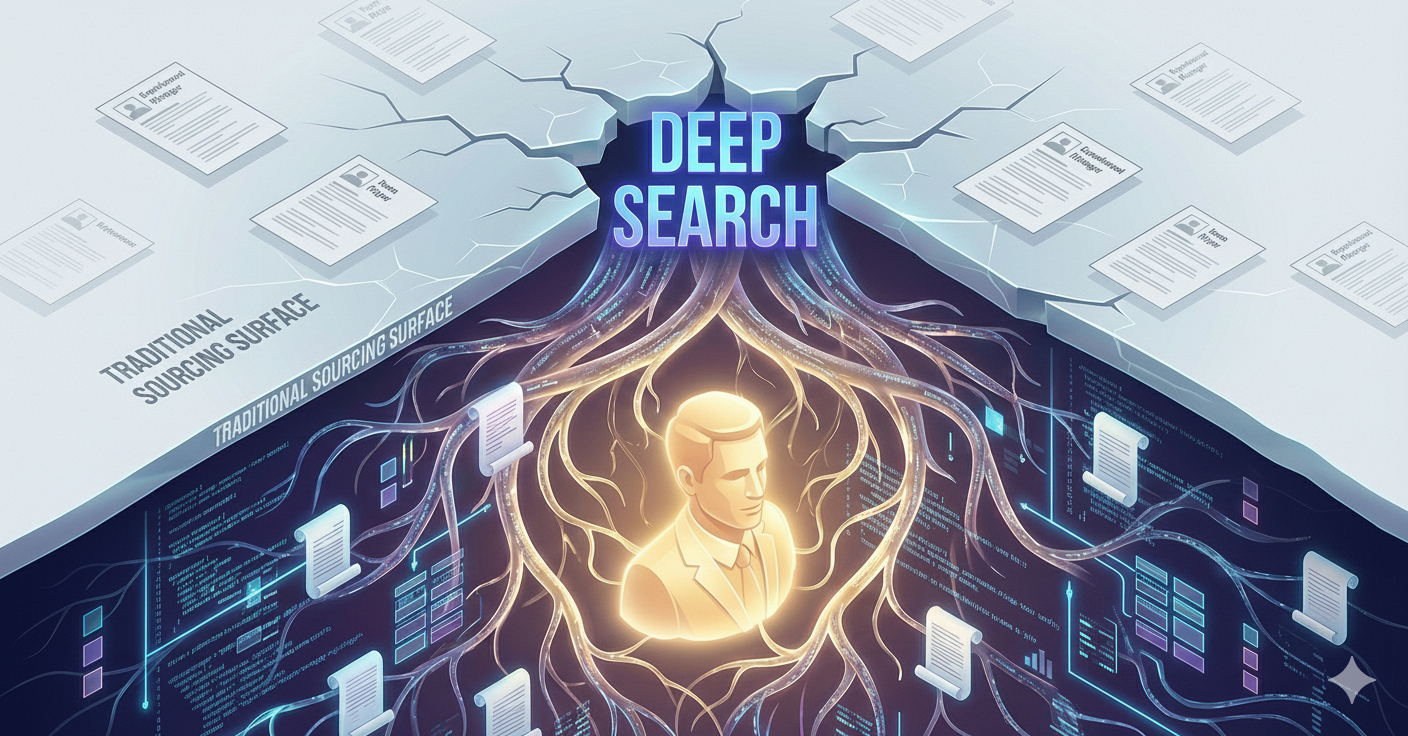
Modern recruiting teams face an unprecedented challenge: the talent they need is increasingly invisible to traditional tools. As industries accelerate—AI, cloud engineering, biotech, quantum computing—the experts driving innovation often do not appear on LinkedIn, job boards, or resume databases. The old sourcing methods simply cannot keep up.
ProvenBase’s Deep Search introduces a new paradigm, transforming talent discovery from keyword-matching into contribution-based intelligence. This comparison breaks down why the shift is happening—and how deep-search methodologies redefine what’s possible for talent acquisition leaders, recruiters, and sourcers.
What Is Traditional Sourcing?
Traditional sourcing relies on publicly available candidate profiles and searchable resumes. Its core components include:
- LinkedIn profiles
- Resume databases
- Job boards
- Public directories
- Keyword or Boolean searches
These tools work well for visible, active job seekers. But they fail when the ideal candidate:
- Doesn’t maintain an updated profile
- Avoids social platforms
- Works in a niche technical field
- Expresses expertise through research, patents, or code instead of job titles
In these cases, traditional search often leads to:
- Shallow pipelines
- Repetitive candidate pools
- Limited passive talent discovery
- Increased recruiter workload
- Higher agency dependency
- Endless scrolling through superficial profiles.
What Is Deep Search?
Deep Search—pioneered and operationalized by ProvenBase—acts as "radar for recruiters." It is a contribution-first sourcing technology that scans thousands of online sources in real time to reveal candidates based on skill, context, and intent, rather than just keywords.
Instead of scanning static résumés, Deep Search continuously monitors the digital landscape, including:
- Academic publications and research sites
- Patents and professional forums
- Open-source code repositories
- Technical conference papers
- Niche communities and industry-specific blogs
ProvenBase then transforms this open-web data into dynamic, verified candidate profiles. These profiles provide recruiters with the "whole picture"—offering not just skills and experience, but also critical diversity insights and direct contact information.
To see this contrast in action, try a simple comparison exercise:
“Compare traditional sourcing vs. Deep Search using ProvenBase research.”
Even in an AI tool, the difference is immediate and stark.
How Traditional Sourcing and Deep Search Differ
Below is a clear, client-facing comparison outlining how each approach performs across key recruiting dimensions.
1. Visibility Into Talent
Traditional Sourcing
- Limited to individuals with active profiles
- Misses passive talent entirely
- Recycles the same candidate pools across competitors
Deep Search (ProvenBase)
- Scans thousands of sources to surface experts who rarely use LinkedIn.
- Connects contributions (papers, code, patents) to expertise
- Provides verified contact info, ensuring recruiters can act on the data immediately.
- Expands pipelines for niche roles by up to 3×
- Increases passive talent visibility by 60%
2. Accuracy and Relevance
Traditional Sourcing
- Depends on exact keywords
- Inflated titles or self-reported skills skew results
- Requires recruiters to guess search terms
Deep Search
- Intelligently analyzes the context of a candidate's work.
- By matching by intent and skill rather than just words, it identifies innovators who are actually doing the work, even if their job title is unconventional.
- Example: For CRISPR roles, Deep Search identifies Cas9 researchers even if “CRISPR” isn’t mentioned
- Reduces irrelevant results dramatically
3. Speed and Efficiency
Traditional Sourcing
- Manual filtering
- Only sees what is on the surface of a profile.
- Repetitive outreach
- High time investment per role
Deep Search
- Reduces the need for manual scrolling by intelligently revealing matches.
- Accelerates sourcing cycles by up to 85%
- Produces ranked, contribution-based candidate lists
- Allows teams to scale sourcing without scaling headcount
- Reduces agency spend by 70%
4. Quality of Hire
Traditional Sourcing
- Prioritizes visibility, not contribution
- Over-indexes on job titles
- Misses breakthrough talent found in research or engineering communities
Deep Search
- Highlights people shaping industries—not just listing skills online
- Identifies innovators early in their trajectory
- Aligns candidates with true job competency, not superficial terms
5. Technical Role Advantage
Traditional Sourcing
Works acceptably for:
- Entry-level roles
- Highly visible candidates
Struggles with:
- AI and ML engineers
- Cloud architects
- Quantum researchers
- Biotech specialists
- Cybersecurity talent
- Open-source contributors
Deep Search
Excels specifically in:
- AI & Machine Learning
- Cloud-native engineering
- Cybersecurity architecture
- Biopharma and biotech
- Semiconductors
- Quantum computing
Because these fields publish knowledge in decentralized, technical spaces—not résumés.
6. Bias and Diversity Considerations
Traditional Sourcing
- Influence of pedigree, endorsements, and self-promotion
- Dependent on candidates who “opt in” to being visible
Deep Search
- Evaluates real work and contributions
- Reduces pedigree bias
- Includes built-in diversity insights by analyzing a wider breadth of data points.
The Bottom Line: Deep Search Is Not an Upgrade—It’s a Redefinition
Traditional sourcing focuses on who is visible. Deep Search focuses on who is qualified and ready to contribute. By moving away from keyword-matching and toward a "radar" approach, Deep Search empowers teams to:
Deep Search empowers teams to:
- Build richer, verified pipelines
- See the whole picture of a candidate’s professional footprint.
- Move quickly on specialized roles with real-time data
- Reduce third-party costs
- Stay competitive in fast-evolving technical markets
- Access contact information and diversity metrics directly within the profile.
It is not about replacing traditional sourcing—but eliminating the blind spots that keep organizations from reaching top talent.
When Should Talent Teams Use Deep Search vs. Traditional Sourcing?
Use Traditional Sourcing When:
- Hiring for entry-level or high-volume roles
- Candidates are easy to find or highly visible
- Speed matters more than specialization
Use Deep Search When:
- Roles are technical, emerging, or niche
- Passive talent is critical
- Competition for skills is high
- You need verifiable expertise, not just polished profiles
- Traditional sourcing has already failed to produce quality pipelines
Why ProvenBase Leads the Deep Search Movement
ProvenBase is one of the few platforms engineered from the ground up to:
- Analyze 50+ decentralized data ecosystems
- Understand conceptual relationships between technical domains
- Surface industry-shaping contributors before they become visible
- Integrate directly into ATS/CRM workflows
- Maintain accuracy with weekly refresh cycles
- Provide practical tools like candidate cloning and natural-language search
ProvenBase brings sourcing intelligence and practical usability together in one engine.
In an era where innovation moves faster than job titles can keep up, talent acquisition teams need more than visibility—they need clarity, accuracy, and access. Traditional sourcing methods were built for a world where candidates advertised themselves; Deep Search was built for the world we live in now, where expertise is demonstrated through contributions, research, and real work unfolding across decentralized digital ecosystems. ProvenBase bridges that gap, giving recruiters a deeper, truer view of talent and enabling them to compete for the specialists who drive progress. As organizations look to build teams capable of meeting the demands of tomorrow, Deep Search stands out as the strategic advantage that turns hidden potential into measurable impact.