America’s Overlooked Workforce: A Recruiter’s Guide to Finding Talent Others Miss
America’s Overlooked Workforce
A Recruiter’s Guide to Finding Talent Others Miss
Employers say qualified candidates are hard to find. Federal labor data suggests recruiting leaders should also ask whether their hiring processes are reaching everyone capable of doing the work.
Somewhere in America, a recruiter is struggling to fill a position.
The job has been advertised, reposted, and promoted across multiple platforms. The hiring manager has reviewed dozens of resumes. Weeks have passed, and the position remains vacant.
The conclusion sounds familiar: There simply aren't enough qualified candidates.
Meanwhile, a professional with a disability may never see that opportunity. Perhaps the employer relies on sourcing channels that don't reach them. Perhaps the application system is inaccessible. Or perhaps the job description includes requirements that have little to do with performing the actual work.
The employer sees a talent shortage. The candidate sees another closed door. Both may be describing the same broken recruiting process.
October is National Disability Employment Awareness Month. The 2026 theme, “Celebrating Value and Talent,” invites employers to examine not only their commitments to disability inclusion but also the day-to-day recruiting practices that determine who gets considered.
The business question is straightforward: If employers are struggling to find talent, why are so many qualified people still encountering barriers to employment?
The disability employment gap: What the numbers actually show
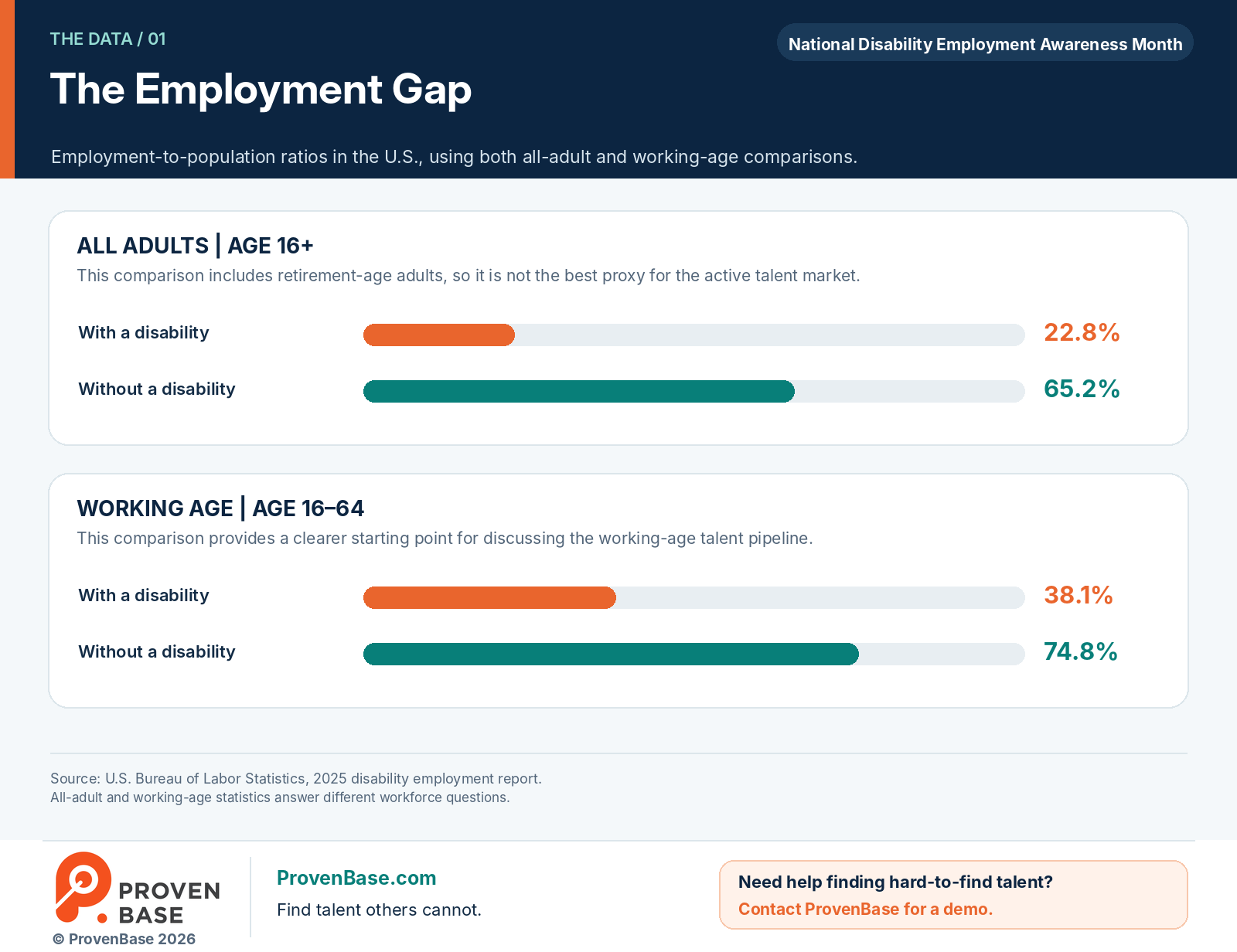
The U.S. Bureau of Labor Statistics reports that, in 2025, 22.8% of people with disabilities age 16 and older were employed, compared with 65.2% of people without disabilities. Those figures cover all adults, including people beyond the traditional working ages.
Looking specifically at people ages 16–64, the employment-to-population ratio was 38.1% for those with a disability, compared with 74.8% for those without. That comparison provides a more useful starting point for discussing the working-age talent pipeline.
Three statistics every recruiter should understand
The BLS measures employment in several ways. In 2025, for Americans age 16 and older:
| Measure | With a disability | Without a disability |
|---|---|---|
| Employment-to-population ratio | 22.8% | 65.2% |
| Unemployment rate | 8.3% | 4.1% |
| Labor-force participation rate | 24.8% | 68.0% |
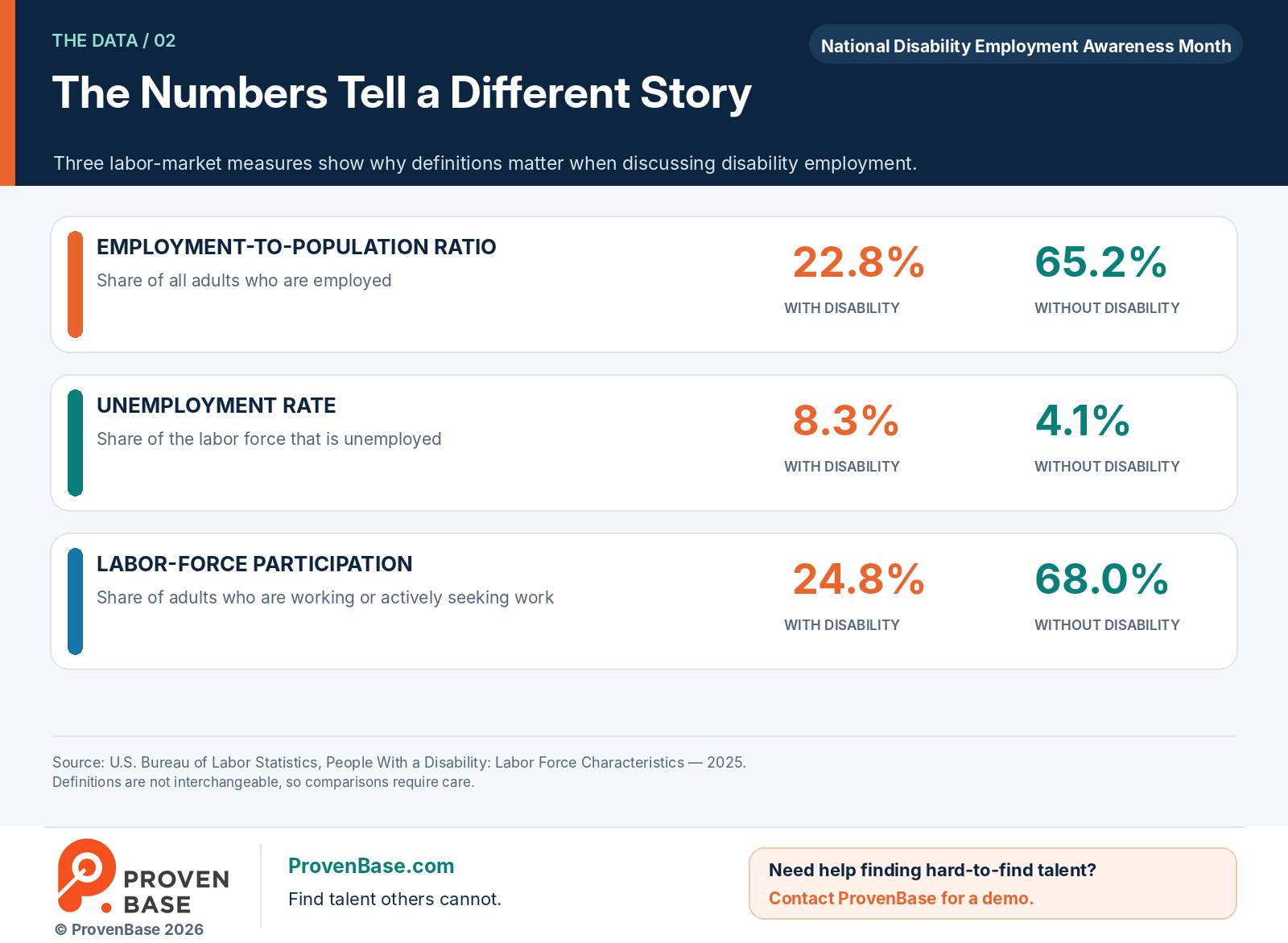
Why the definitions matter: The employment-to-population ratio is the share of people employed. The unemployment rate counts people without work who are in the labor force and actively seeking employment. Labor-force participation includes people employed or looking for work. These are not interchangeable measurements.
The 2025 BLS annual figures exclude October because labor-force data were not collected during the federal government shutdown. About half of the people with disabilities in the BLS population were 65 or older. Neither the total population outside employment nor the unemployment gap is a direct count of people qualified and available for any particular job.
What the data show is an enduring gap that deserves employers' attention. Recruiters should ask whether their current systems reveal the full range of qualified candidates they could reach.
Five ways employers overlook qualified candidates
Most recruiters do not intentionally exclude people with disabilities. Barriers often arise from ordinary hiring practices that have gone unexamined.
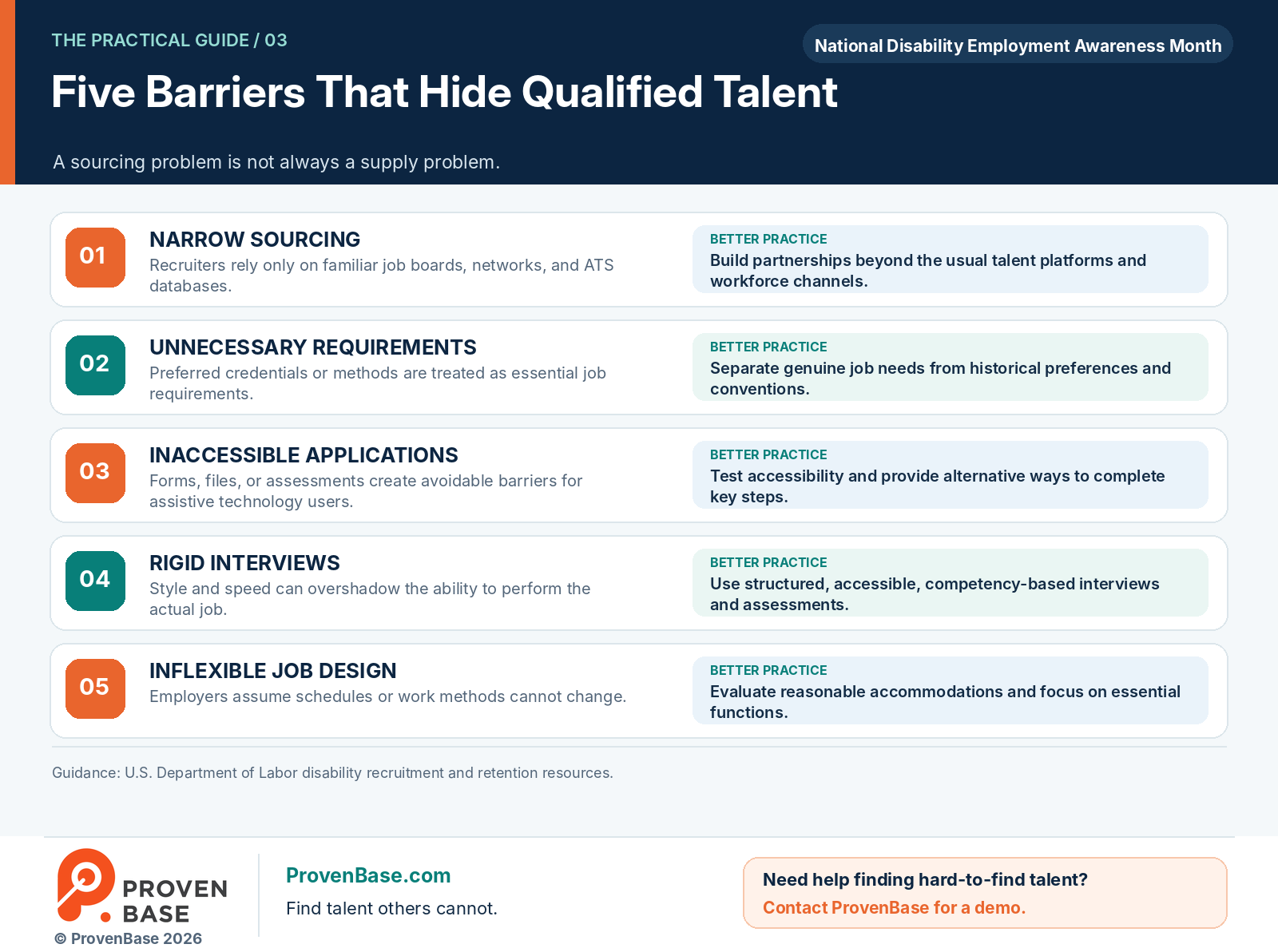
1. Searching the same talent pools repeatedly. Job boards, professional networks, and ATS databases are useful, but not comprehensive. Recruiters who never build relationships with state vocational rehabilitation agencies, disability employment networks, or community workforce partners may miss relevant talent.
2. Treating preferred qualifications as essential. A degree, arbitrary years-of-experience requirement, or particular physical method of performing work may reflect a previous employee rather than what the role truly requires. Employers should identify essential functions and consider reasonable accommodations where applicable.
3. Using inaccessible application technology. Unlabeled online forms, incompatible assessments, documents that screen readers cannot interpret, and inaccessible interview platforms can prevent qualified applicants from completing a hiring process.
4. Rewarding interview style over job capability. Interviews can put too much emphasis on conversational speed, eye contact, or conventional presentation. Job-related questions, consistent evaluation criteria, accessible assessments, and appropriate accommodations offer a clearer picture of ability.
5. Assuming work arrangements cannot change. Certain schedules or methods are genuinely essential. Others may be flexible. Employers should evaluate accommodation requests individually rather than dismissing candidates because they work differently.
A recruiting process cannot accurately measure the available talent market if qualified applicants cannot meaningfully participate in it. The Department of Labor's recruitment and retention guidance offers additional practical direction.
Where recruiters can find qualified candidates with disabilities
Employers do not have to invent a disability-inclusive sourcing strategy. Government agencies, community workforce organizations, and nonprofit networks already provide guidance, partnerships, and in some cases direct candidate connections.
EARN
Recruiting strategies, employer education, and inclusive hiring tools.
State Vocational Rehabilitation Agencies
State and local programs that support job seekers and employers.
American Job Centers
Workforce partnerships and local employer connections.
Job Accommodation Network (JAN)
Free, confidential accommodation advice and accessibility guidance.
Disability:IN
Employer networks, education, and disability inclusion programs.
National Organization on Disability
Research and employer-oriented resources.
SourceAmerica
Disability employment partnerships and opportunities.
Workforce Recruitment Program
A federal employer talent source for eligible students and recent graduates with disabilities.
AbilityLinks
A disability-focused job and employer network.
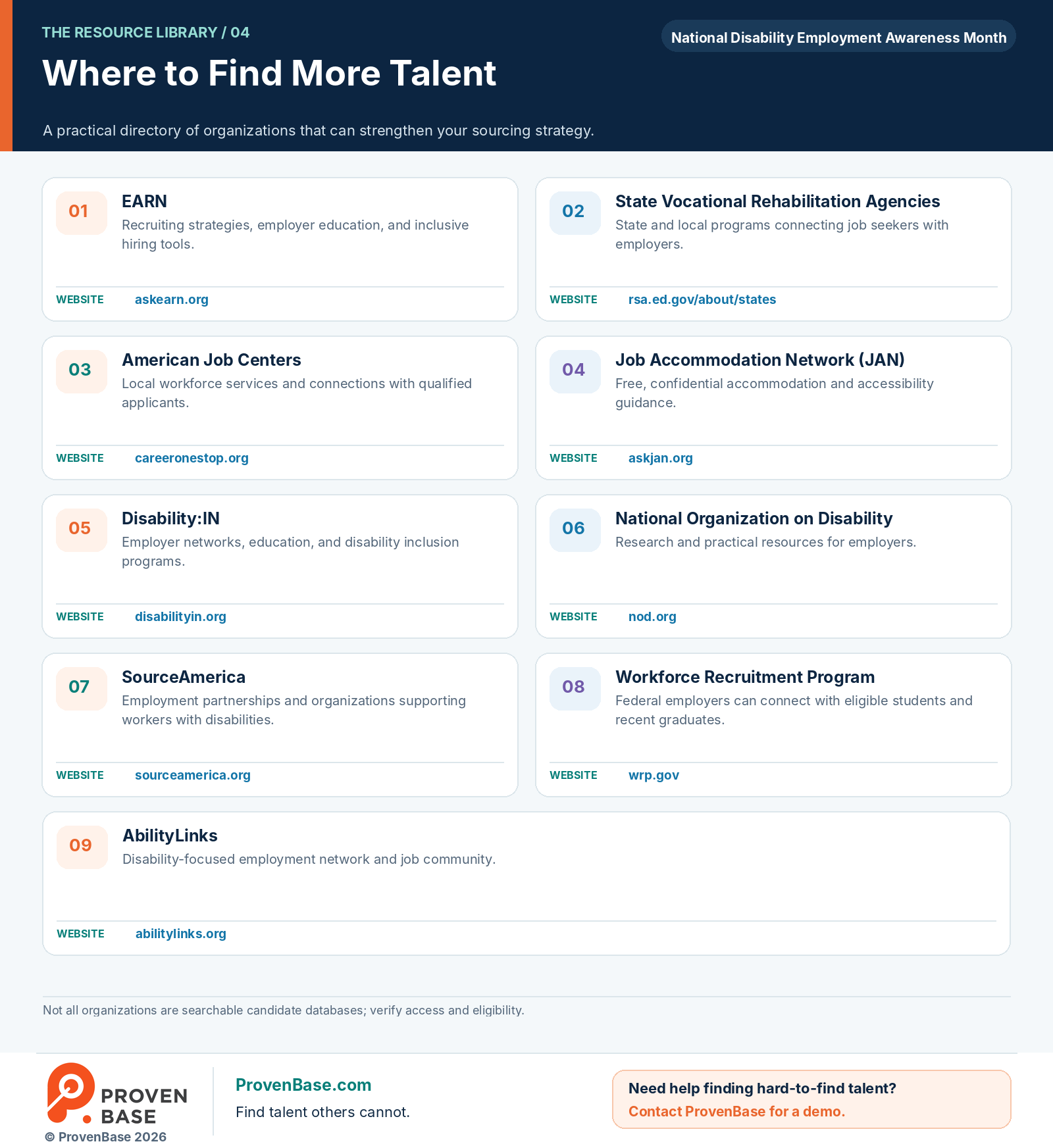
Not all these resources are searchable resume databases. Some connect employers with candidates; others provide training, organizational partnerships, or accommodation assistance. Confirm current program eligibility and services before building your sourcing plan around a particular organization.
Five questions to ask a disability employment partner
A strong partnership should answer practical business questions: Which occupations and locations does the organization serve? What qualifications do participants bring? How does it refer candidates to employers? What support is available during interviewing and onboarding? How will success be measured?
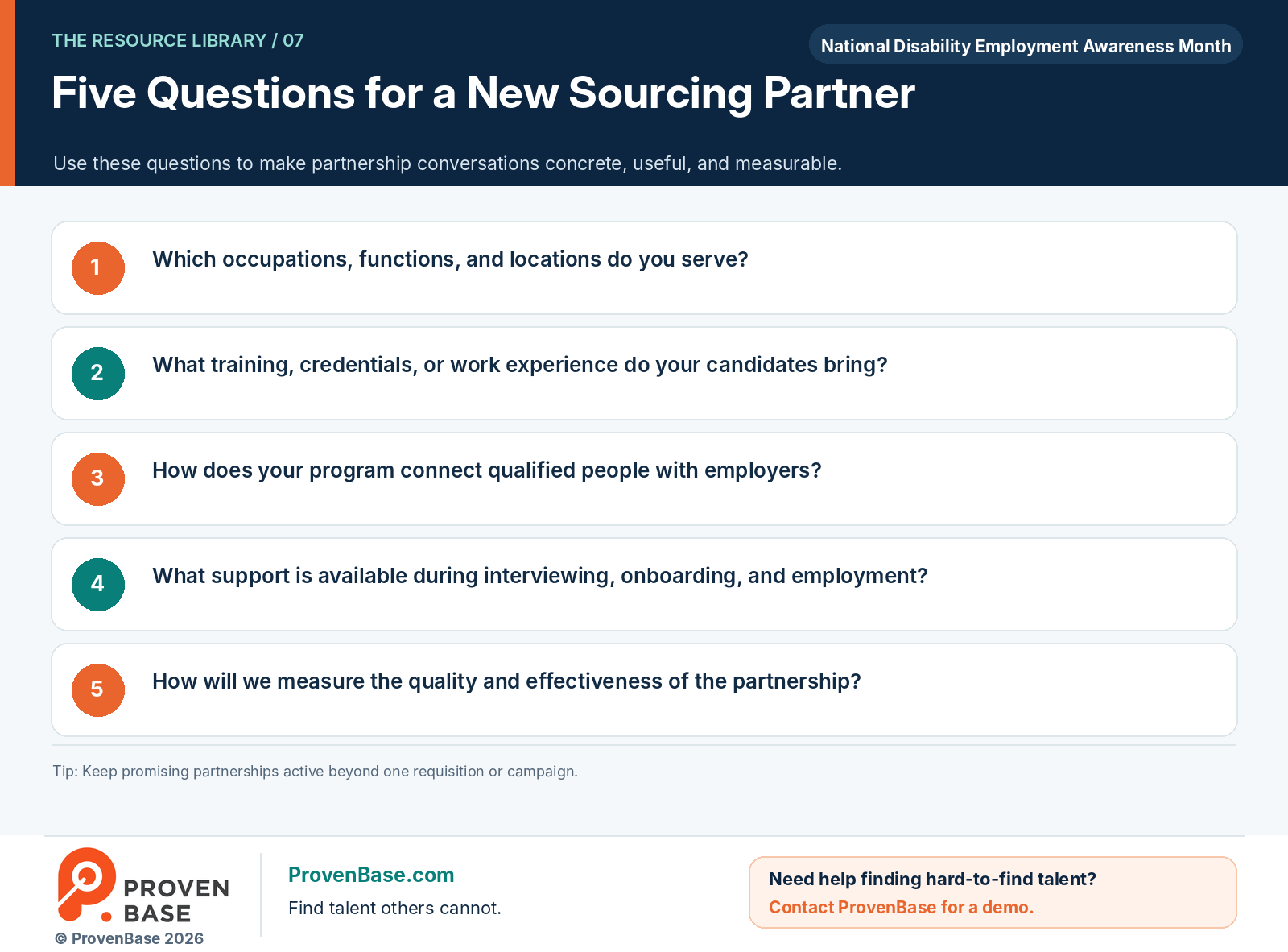
The goal is a relationship that helps qualified people and employers connect over time, not an occasional request for resumes when a difficult requisition stalls.
Workplace accommodations: What do they actually cost?
One persistent misconception is that workplace accommodations are necessarily expensive or difficult to implement.
The Job Accommodation Network's 2025 Cost and Benefits of Accommodations report found that, among 1,425 employers reporting costs for accommodations they had implemented, 61% said the accommodation cost nothing, 33% reported a one-time expense with a median of $300, and 6% reported ongoing costs with a median annual cost of $2,400.
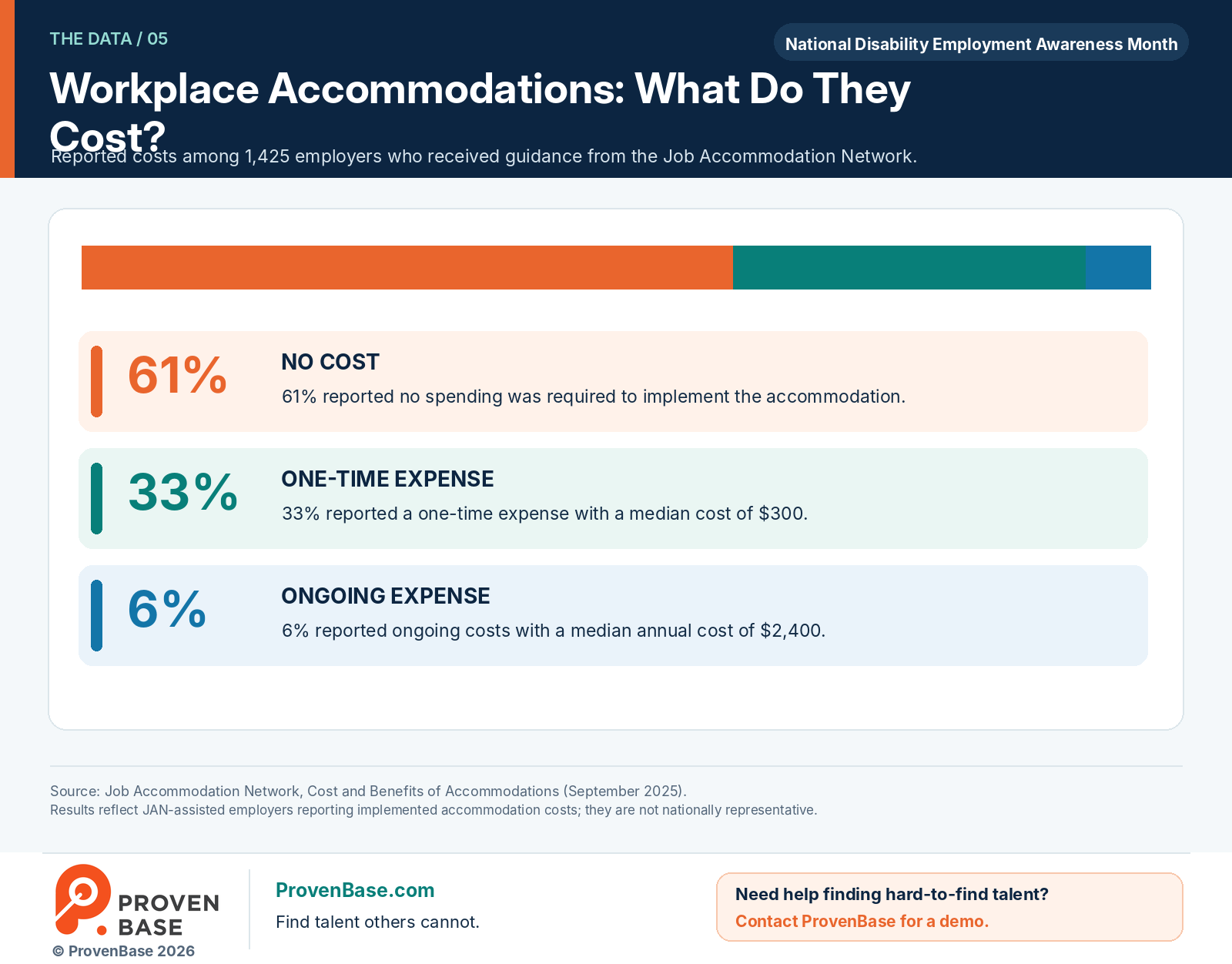
These are responses from employers who had contacted JAN for advice, not a nationally representative estimate of all accommodations. Actual needs vary. Examples include adjusted schedules, accessible software, communication support, workstation modifications, and different ways of completing essential tasks.
The responsible approach is not to presume accommodations are always free. It is to assess a specific request with reliable guidance rather than making assumptions about the person or the cost. JAN offers free, confidential assistance.
A 30-day plan for expanding your recruiting pipeline
Disability-inclusive recruiting does not require an organization-wide overhaul on day one. Start with one open position, find barriers in the existing process, and test a more inclusive approach.
Week 1 — Audit
Review job requirements, application accessibility, interview methods, and accommodation procedures.
Deliverable: Barrier inventory.
Week 2 — Expand
Contact three disability employment or workforce organizations.
Deliverable: Partner shortlist.
Week 3 — Prepare
Train recruiters and hiring managers on accessible, job-related evaluation.
Deliverable: Updated hiring workflow.
Week 4 — Pilot
Apply the approach to one difficult-to-fill job and measure results.
Deliverable: Baseline, findings, and next steps.
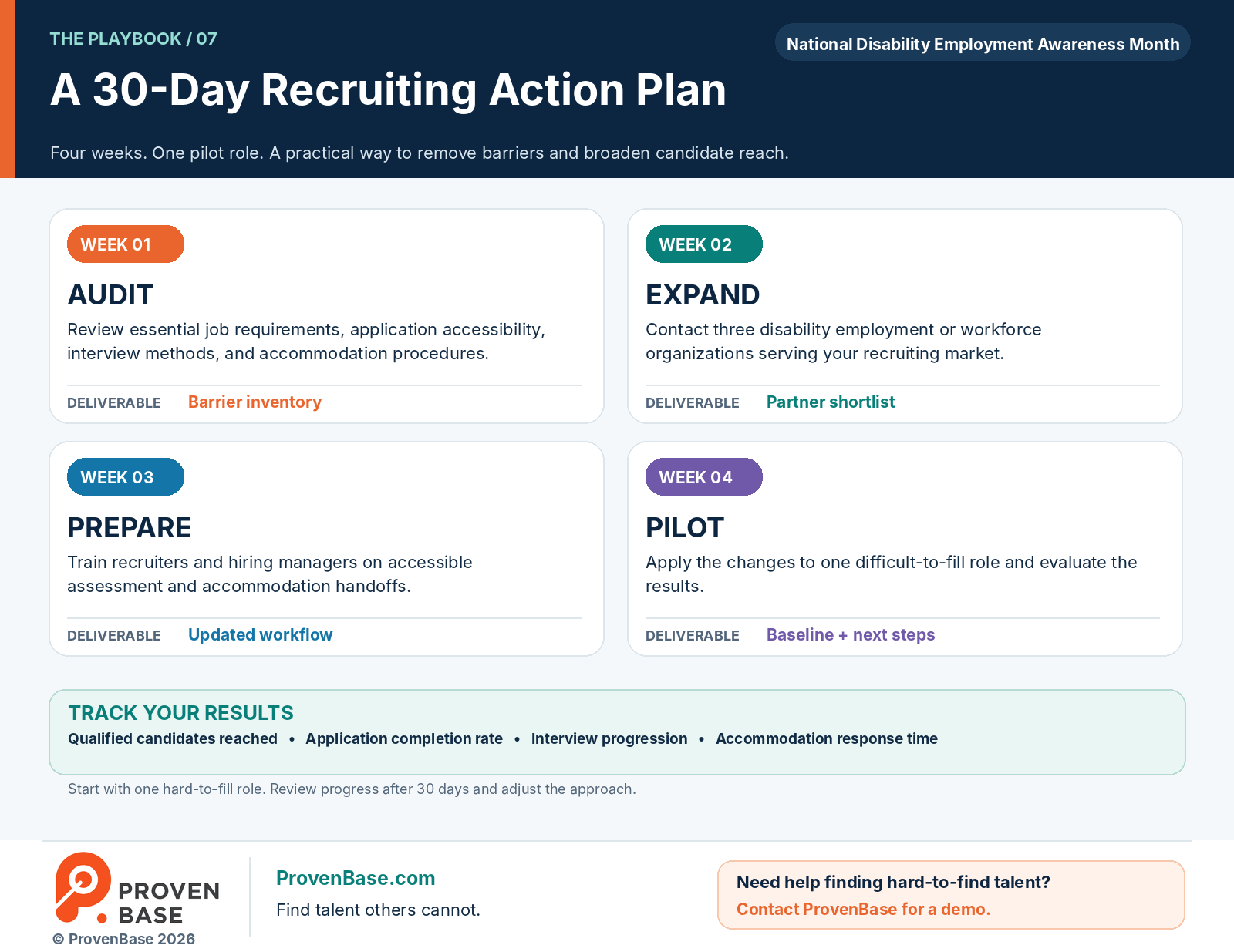
Measure qualified candidate reach, application completion, hiring-stage progression, response times to accommodation requests, and relevant hiring outcomes. Handle disability-related information lawfully, including requirements for voluntary disclosure and confidentiality. The objective is to remove barriers, not to infer or track a person's disability from their resume or online profile.
Ten questions every recruiting team should ask
Use this audit during an actual requisition review. Invite recruiters, hiring managers, TA operations, and accessibility partners to examine the same process.
- Are job requirements connected to essential functions?
- Can applicants using assistive technologies complete the application?
- Do candidates know how to request an accommodation?
- Can the organization provide accessible interviews and assessments?
- Are recruiters using consistent, job-related evaluation criteria?
- Does the team have working relationships with disability employment organizations?
- Do sourcing channels extend beyond familiar talent networks?
- Are accommodation requests handled promptly and confidentially?
- Does the organization measure where candidates face barriers?
- Are findings used to improve the process?
This checklist is a starting point, not a legal compliance certification. Employers should consult qualified counsel or accessibility specialists about their particular obligations.
The business case goes beyond compliance
Employers should comply with disability employment laws because those obligations matter. But compliance is not a complete talent strategy. A broader opportunity is to build a recruiting process that identifies job-related capability more accurately.
Disability is not an occupation or a single set of experiences. People with disabilities work in healthcare, manufacturing, technology, education, finance, service industries, and virtually every other part of the economy. Some are experienced professionals. Others are changing careers, entering the workforce, or returning after time away.
Employers that treat disability recruitment as a narrow initiative can miss the larger point: stronger recruiting systems make it easier to evaluate qualified people with different experiences fairly.
Before declaring a talent shortage, ask another question
Some talent shortages are real. Credential requirements, location, compensation, demographics, and limited supplies of particular skills can make jobs genuinely hard to fill.
But an employer should also examine whether its own hiring process is making the shortage appear worse than it is.
Are recruiters searching widely enough? Are requirements defensible? Can qualified candidates access the application process? Have employers built relationships with organizations that reach people outside conventional sourcing channels?
National Disability Employment Awareness Month is an opportunity to ask these questions and act on the answers.
Before declaring that qualified candidates cannot be found, ask whether everyone capable of doing the work has been given a fair opportunity to be considered.
ProvenBase helps recruiting teams look beyond familiar talent sources to discover qualified professionals for difficult-to-fill roles. Bring us your toughest recruiting challenge.